
Measurements are always subject to some uncertainty. The minimum uncertainty is set by the resolution of the device used but repeated measurements may reveal a range of readings, which is more significant than the instrument resolution when determining uncertainty.
In A-level Physics calculations, uncertainties are combined using two simple rules;
- If the calculation involves adding or subtracting quantities then the absolute uncertainty in the final value is found by adding the absolute uncertainties in the measurements.
- If the calculation involves multiplying or dividing quantities then the percentage uncertainty in the final value is found by adding the percentage uncertainties in the measurements.
This can be expressed in symbols, as shown below;

To see how this works in practice, consider an investigation to find the spring constant for a jumping toy. There is a previous article explaining the relevant experiment (see https://physbang.com/2025/09/20/how-high-does-a-spring-toy-jump/) so in this post we will just look at the calculation and its uncertainties.
If the mass and jump-height of the toy are measured, the spring constant can be determined using a conservation-of-energy approach that, for simplicity, assumes all of the toy’s stored elastic strain energy before launch is converted (via kinetic energy) into gravitational potential energy after launch.

where k is the spring constant, ε is the compression of the spring, m is the mass of the toy, g is the gravitational field strength and h is the maximum height of the toy’s jump.
One of my students carried out this experiment and obtained the following results;

The jump heights were fairly consistent and can be averaged to a mean height of 0.79 m with a range from 0.74 m to 0.81 m, giving an uncertainty (based on ± half the range) of ± 0.035 m.
There might be a case for eliminating the 0.74 m result as this was significantly outside the range of the other measurements. That being the case, the mean jump height becomes 0.80 ± 0.015 m.
The mass has an uncertainty determined by the resolution of the digital pan-balance used so the correct way to state the mass is 9.00 ± 0.01 g. When converted to kilograms, the mass will be 0.00900 (the trailing zeroes are essential to keep the correct level of precision in the original measurement) with an uncertainty of ± 0.00001.
The extension is found by subtracting the compressed height of the toy from its natural height. Each of these two measurements has its own uncertainty. In theory, the subjective nature of reading a length on a rule allows an uncertainty of half the smallest division (± 0.5 mm) but the three-dimensional shape of the toy means it is probably more realistic to quote measurements to the division size (± 1 mm).
When the two heights are subtracted, the absolute uncertainties are added, giving a compression of 2.0 cm (6.0 – 4.0) and an uncertainty of ± 2 mm. Converting everything to metres gives a compression (ε) of 0.020 ± 0.002 m.
It may look as if we can now do the calculation to find the spring constant but actually there is also a level of uncertainty in the value of the gravitational field strength, which varies at different points on the Earth’s surface and at different altitudes above sea level.
In Jersey, the value of “little g” is close to the commonly stated value of 9.81 N kg–1 but at the North Pole the value is greater, and at the equator it is less, because the Earth is not a true sphere. There are also variations due to the density of the surface material; the gravitational field strength is less on the oceans than it is on land.
BRIEF DIVERSION: There is a nice animation showing higher and lower areas of “gravity” around the world on NASA’s Scientific Visualization Studio website (https://svs.gsfc.nasa.gov/3655/) and the LivePhysics website has an interactive tool that displays the value of “little g” for any location (https://livephysics.com/tools/gravity-around-world/).
Returning to the spring toy, we could probably assume the value of “little g” is fully correct for our location but if we were being meticulous then we should probably state it as 9.81 ± 0.005 N kg–1.
The “2” in the equation is an absolute value that has no uncertainty as it derives from the fact that the energy in a compressed spring is related to the average force used to compress the spring.
So now we can do the calculation to determine the value for the spring constant.

To find the uncertainty in the final value we must add the individual percentage uncertainties, which are calculated by dividing the absolute uncertainty by the value itself then multiplying by 100. The various values are collated in the table below;
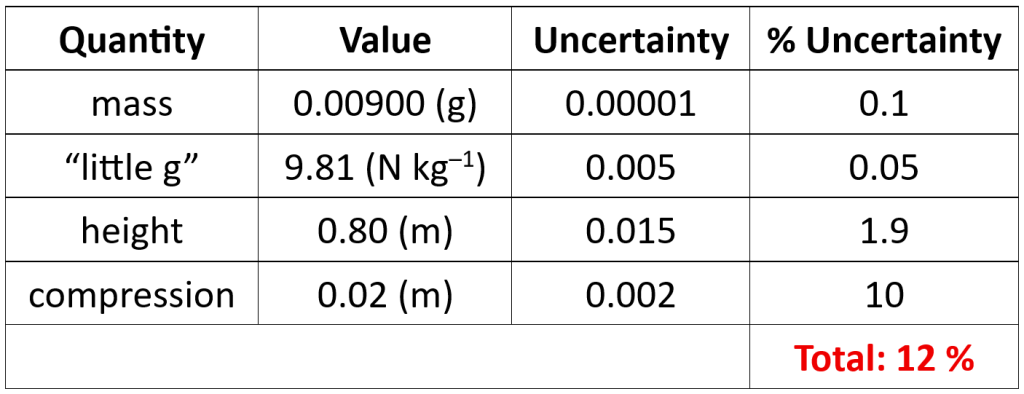
The table is particularly useful in revealing the biggest and smallest contributions to the overall uncertainty. This in turn indicates where work should be focused to provide better precision in any future experiments (measuring the amount of spring compression). It also shows there was little point in worrying about the uncertainty in the value of “little g”, or even the uncertainty in the mass, as almost all the uncertainty comes from the spring compression with another significant contribution from the range of jump heights.
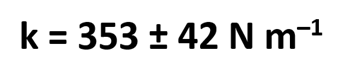
Knowing that the total percentage uncertainty was ± 12 %, we can use this value to calculate an absolute range of 42 (0.12 x 353).
Our complete answer is therefore;
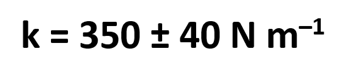
There is, however, one final step, which is to rewrite the final value in a way that is more consistent with the known uncertainties. This is based on the rule that says a value may not be quoted to higher precision than its uncertainty. A similar argument applies to the number of significant figures in the uncertainty.* Therefore;
* I have made this statement without any justification so you may decide to ignore it. Or you may like to read the various guides for handling uncertainties that have been published by the BIPM (international organisation for weights and measures): these are available at https://www.bipm.org/en/committees/jc/jcgm/publications. A nice short summary is given in the lab-guide notes offered by Dr Justin Maresh of DePaul University, Chicago (https://condor.depaul.edu/jmaresh/labreports/Writing_Guidelines6.html).


