
Estimating the size of a nucleus using electrostatic repulsion can be traced back to the invention of an ultra-sensitive apparatus, which measured forces in terms of the twisting of a fine wire, dating from the 18th Century. This device, known as a torsion balance, is often attributed to the French engineer and physicist Charles Augustin de Coulomb but may well have been designed previously by English natural philosopher and Fellow of Queen’s College, Cambridge, John Michell.
Michell’s focus was on investigating gravity, work that was continued and completed by another Cambridge physicist, Henry Cavendish. Interestingly, Michell wrote to Cavendish in 1784 regarding a link between gravity and light, proposing the potential for “dark stars” where the gravitational field is so strong that its escape velocity exceeds the speed of light. Effectively, John Michell suggested the idea of black holes nearly 200 years before they were formalised by modern astronomers.
Coulomb, on the other hand, wanted to investigate electrostatic forces and his version of the torsion balance was said to be “so sensitive that a force equivalent to about 1/100,000 of a gram could be detected” (Biographical Encyclopedia of Scientists, 2009).
In his experiments, Coulomb took two balls that were charged with “the same kind of electricity” then recorded how much closer they became when the supporting wire attached to one of the balls was twisted by different amounts. His initial results are shown below;
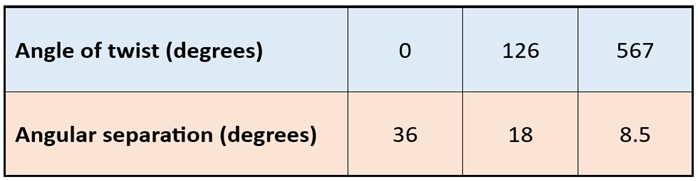
Knowing that the angle of twist is directly proportional to the force being applied on the object, and observing that roughly four times as much twist was required to halve the separation from 18 to 8.5 degrees as had been needed to achieve the initial halving from 36 to 18 degrees, Coulomb proposed his “fundamental law of electricity”, which translates from the original source as follows;
“The repulsive force between two small spheres electrified with the same kind of electricity is in inverse ratio to the square of the distance between the centres of the two spheres.”
Further work led to the now-familiar equation for Coulomb’s law;
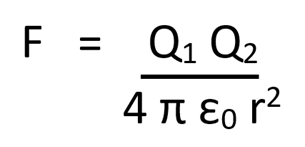
Where Q1 and Q2 are the charges on the two spheres, r is the distance between the centres of the spheres and 1/4πε0 is the constant of proportionality that arises from both the spherical geometry (4π) and the permittivity of free space (ε0). In calculations, it is convenient (and often acceptably accurate) to give 1/4πε0 a collective value of 9 x 10⁹ although it is more correct to use the true value of ε0, which is 8.85 x 10⁻¹². The unit for ε0 is usually stated as farads-per-metre (F m–1) but using the equation above it can also be derived as coulombs-squared-per-newton-per-square-metre (C2 N–1 m–2).
Note that the equation applies for both real spherical charges (conducting spheres) and idealised point charges that have neither geometry nor size. The force is positive when the charges are of the same type (both positive or both negative) and the force becomes negative when the two spheres have opposite charges. The force calculated is therefore repulsive when its value is positive and becomes attractive when it is negative.
How does all of this relate to the size of a nucleus? To answer that we first need to realise Coulomb’s force is due to the electric field that exists around any charged particle. Although we need two particles to create a force, a single charged particle has its own electric field.
The equation for the electric field (E) around a charged spherical object is given below. Note that the symbol for electric field (E) must not be taken to suggest some form of energy: we will come to the energy aspect shortly.
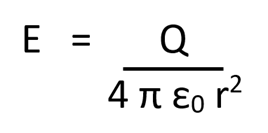
You will notice the equation above is the same as the Coulomb’s force equation except there is only one charge, which is the charge on the object creating the electric field.
The unit for electric field is newtons-per-coulomb – and the “coulomb” here refers to the second charge that experiences the field due to the first charge, and therefore the force that exists between two charges.
This can sound confusing because it suggests one charge is more important than the other but that is not the case. In fact, the idea of an electric field simplifies matters because we can now think about the energy transfer (work done) when a second particle with unit charge moves through the field of an existing particle that holds any amount of charge (Q).
Like Coulomb’s law, the electric field strength is inversely proportional to the square of the distance from the centre of a charged particle, as shown in the graph below;
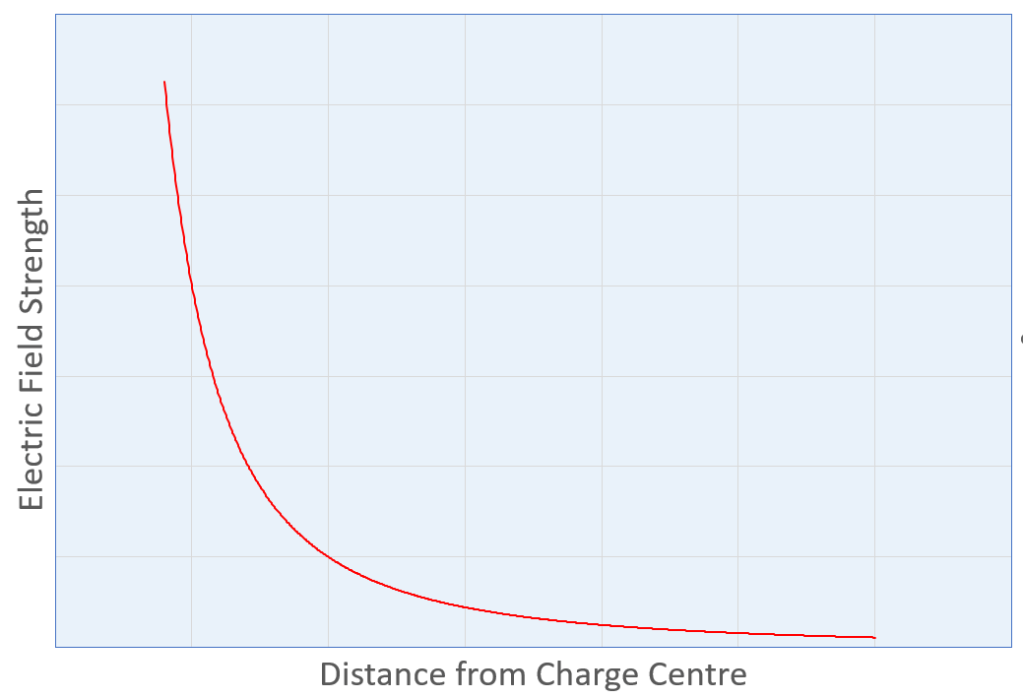
If another charged particle moves closer to, or away from, the particle that created this field then energy will be transferred. The amount of energy transferred is equal to the area between the curve and the x-axis bounded by the initial and final distances, which is in turn equal to the integral of the curve between the appropriate limits.
More usefully, we can consider a static particle that creates the electric field and a moving particle with unit charge that approaches “from infinity” to any distance (r) measured between the centres of the two particles at that location. Assuming the static particle and the incoming particle both have a positive charge, the incoming particle must do work against the repulsive electric field and in the process gains potential energy.
If we set the potential energy of a free particle (at infinity) to be zero then the work done by an incoming particle to reach a charge-centre separation (r) within the field is given by;
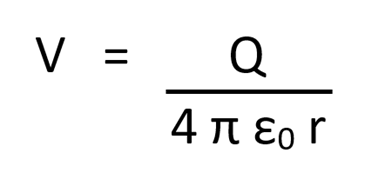
With this equation of charge potential, we can now return to the matter of estimating the nuclear radius using electrostatic repulsion.
When alpha particles (+2 charge) are fired towards a gold nucleus (+79 charge) the alpha particles lose kinetic energy and gain electric potential energy (Ep) as they move closer to the gold nucleus.
Bearing in mind that the equation for the electric potential (V) has units of joules-per-coulomb, we need to take account of the fact that alpha particles have non-unit charge.
The general equation for electric potential energy is obtained by multiplying the charge-potential equation by the incoming charge (Ep = VQ). Its final form echoes the original Coulomb’s law equation except that it involves energy rather than force and is proportional to 1/r rather than 1/r2.
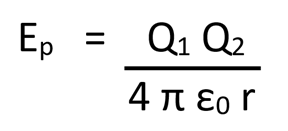
The closest approach of the alpha particle to the gold nucleus will occur when all of the alpha particle’s kinetic energy has been transferred to electrical potential energy. Therefore, knowing the energy of the incoming alpha particle we can calculate its closest approach before rebounding – and this in turn will provide an estimate for the maximum size of the nucleus.
As an exercise, you should rearrange the equation for electric potential energy, shown above, to make separation (r) the subject and substitute the following values;
- Q1 = 2 x 1.6 x 10–19 C
- Q2 = 79 x 1.6 x 10–19 C
- Ek = Ep = 4.9 MeV (converted to joules or incorporated in an appropriate way)
- 1/4πε0 = 9 x 10⁹ J m C–2
The final answer should round to 4.6 x 10⁻¹⁴ m (46 fm), which is much higher than any value quoted in current textbooks.
Although a higher-energy alpha particle might have been able to get even closer, giving a lower estimate for the maximum size, there is a far better method that can be used to determine values for nuclear radii. That method is electron diffraction, which is a topic for another time.
FURTHER READING:
There is a great summary of different methods for determining the nuclear radius at https://www.nexus-edu.ai/a-level/physics/nuclear-physics/nuclear-radius-mass-energy-and-binding-energy/estimating-nuclear-radius-by-two-methods and a set of summary notes is available at https://www.physicstutoronline.co.uk/wp-content/uploads/2018/09/Nuclear-radius-NOTES.pdf.
A nice explanation of Coulomb’s apparatus is on the University of Flensburg website, at https://www.uni-flensburg.de/en/working-group-physics/histolab/thematical-subsections/electricity/coulombs-torsion-balance. Another explanation, together with some experimental methods, is given in one of Illinois Institute of Technology’s lab assignments, which is available at https://www.iit.edu/sites/default/files/2019-11/coulomb_s_lawrev.pdf.


Why can we assume all the alpha particle’s initial kinetic energy becomes electric potential energy?
LikeLiked by 1 person
We can assume anything we want so the issue is really whether this assumption is correct – or, more importantly, whether it is useful.
Picturing the alpha particle as a ball that is rolled up a hill (representing the electric field of the nucleus) is a convenient way to justify the suggested energy transfer using the analogy of initial kinetic energy transferring to gravitational potential energy (representing electrical potential energy). This assumption provides us with an alternative approach for estimating the size of the nucleus without having to count hundreds-of-thousands of flashes of light in the Rutherford scattering experiment (see https://www.fizzics.org/rutherfords-gold-leaf-experiment/ for a summary reminder). The answer we get isn’t correct so rather than looking for holes in the analogy we’ll move on to electron diffraction as a better technique to use. But you are right to question whether we can apply everyday thinking to the sub-atomic world, and whether other energy transfers might occur.
LikeLiked by 2 people