The term “Hubble tension” refers to discrepancies in the value of the Hubble constant, which in turn indicates the rate of expansion of the Universe. In particular, the “tension” arises because two different techniques for calculating the constant give significantly different values.
For a brief introduction to the Hubble constant, see https://physbang.com/2026/04/26/red-shift-and-the-age-of-the-universe/ or NASA’s summary at https://science.nasa.gov/mission/hubble/science/science-behind-the-discoveries/hubble-cosmological-redshift/.
Although the constant bears Edwin Hubble’s name, it was Vesto Slipher who first collected systematic data linking red-shift with distance but he didn’t realise the significance of his findings. The first analysis was written by Georges Lemaitre, two years before Hubble’s own paper. Hubble’s initial data weren’t very convincing and it was only with the help of Milton Humason that the constant for the expansion of the Universe became more certain (see https://starchild.gsfc.nasa.gov/docs/StarChild/questions/redshift.html).
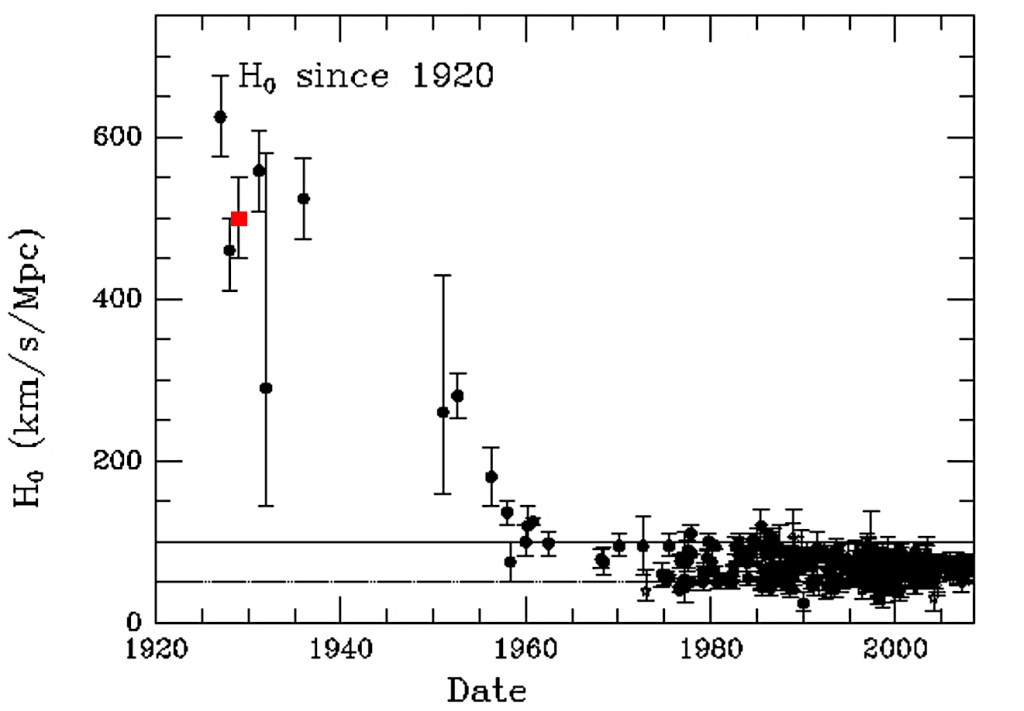
To understand the Hubble tension it is necessary to understand the two different techniques that are used to measure the Hubble constant, starting with the “distance ladder”. This uses measurements of distances for nearby objects to determine the position of objects that are farther away. In the distance ladder technique, all measurements of longer distances rely on previous measurements made at shorter distances.
Distances to the closest objects are measured geometrically, using parallax. Greater distances are measured using standard candles, which are objects of known luminosity that appear dimmer because they are farther away. There is a short round-up of distance-ladder measurements on the Astronomy magazine website, at https://www.astronomy.com/science/the-cosmic-distance-ladder-how-we-measure-an-infinite-universe/ and a summary of no fewer than 26 distance-ladder techniques by UCLA Professor Ned Wright at http://www.astro.ucla.edu/~wright/distance.htm.
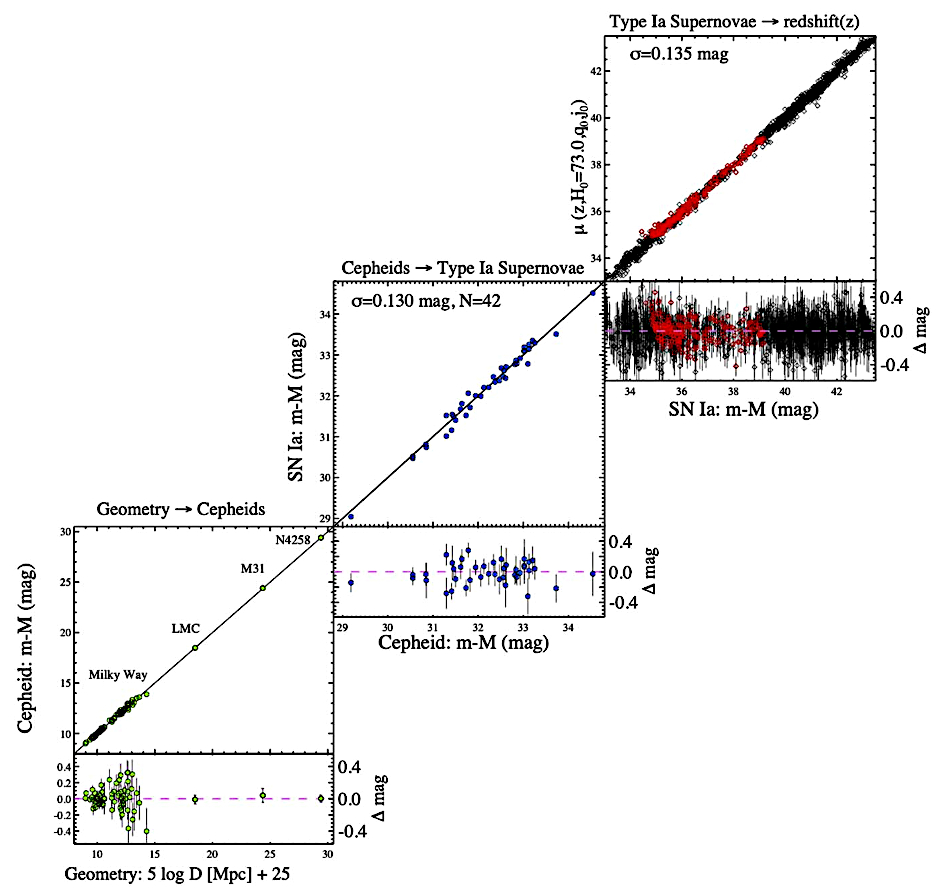
The diagram above comes from a very detailed paper that was published by the Institute of Physics in May 2022. It is a formidable discussion of different approaches and I strongly recommend it as a way to gain a good appreciation of the nuances of Hubble constant measurements. The bottom line is a mean value for the Hubble constant of 73.04 ± 1.04 km s−1 Mpc−1.
There is also a more recent paper (April 2026) available on the Astronomy and Astrophysics website reporting a similarly broad-ranging analysis that obtained a mean value for the Hubble constant of 73.50 ± 0.81 km s−1 Mpc−1.
Both papers are freely available (open access): the link to the first paper is in the caption above and the second paper is at https://www.aanda.org/articles/aa/pdf/2026/04/aa57993-25.pdf.
There is, however, a completely different way in which the Hubble constant can be measured – using information contained within the Cosmic Microwave Background (CMB). Two values for the Hubble constant from CMB analyses are given in the April 2026 paper just mentioned; they are 67.24 ± 0.35 km s−1 Mpc−1 and 68.51 ± 0.58 km s−1 Mpc−1.
In summary, using distance-ladder techniques we get values for the Hubble constant of around 73.3 km s−1 Mpc−1 whereas CMB analysis gives values around 67.8 km s−1 Mpc−1. Clearly the values for the two ways of measuring the constant are significantly different from each other – and that is what is meant by the Hubble tension.
If this were the end of the story, things would be left in a very unsatisfactory state as we haven’t discussed exactly how the CMB yields a figure for the expansion of the Universe (the Hubble constant). The technique is based on Baryon Acoustic Oscillations (BAO) and is quite detailed so I will cover it separately, in a later post.
For now, let me finish by explaining the units used for the Hubble constant, which expresses how fast objects are receding at different distances. The idea is that closer objects are receding (moving away from each other) more slowly and distant objects recede quicker but always with a constant ratio between distance and velocity (recessional speed). The velocity is measured in kilometres-per-second (km s−1) and the distance is measured in megaparsecs (Mpc). The distance actually has a minus-one power (Mpc−1) because the number is a ratio; velocity / distance.
Megaparsecs are millions of parsecs. One parsec is the distance at which one astronomical unit (the mean radius of the Earth’s orbit around the Sun) equates to a viewing angle of one arc-second, which is in turn 1/3600 of a degree. It may be more helpful to know that one parsec is very roughly the distance from Earth to Proxima Centauri, which is our closest star after the Sun. Proxima Centauri is actually 1.3 parsecs away but that is nothing compared to the millions of parsecs used in the ratio for Hubble’s constant.


One thought on “Hubble Tension Part 1: The Distance Ladder”