Stars can be characterised by their absorption lines, which reveal their temperature and composition. There is more detail about this in two recent posts about the HR diagram and stellar classification. A similar approach can also be used to characterise entire galaxies but in this case the aim is to determine how quickly they are receding (moving away) from the Earth.
This work is often linked to the name of Edwin Hubble, who analysed the light received from distant objects (originally called nebulae but now known to be galaxies) to determine whether they were moving relative to the Earth. There is a summary of Hubble’s work in a separate post about the Big Bang.
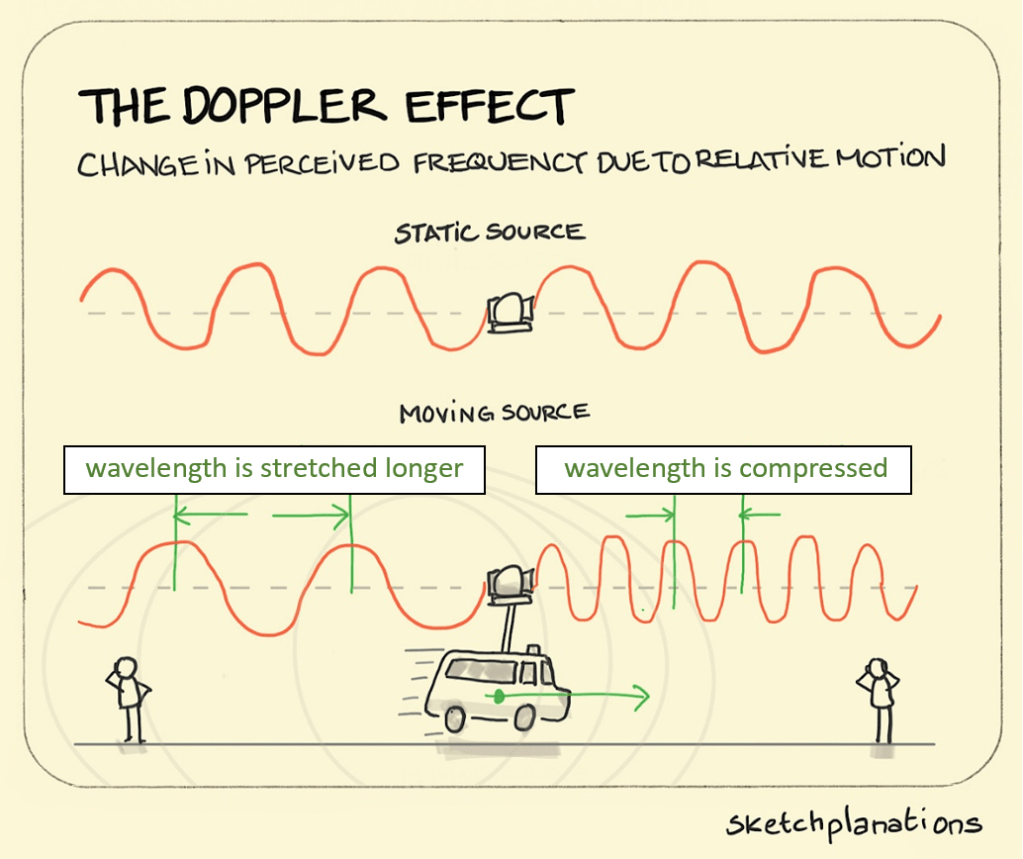
The crucial thing to know is Hubble’s analysis was based on the Doppler effect, which describes the change in pitch heard when a fast-moving vehicle speeds past a stationary observer. As the vehicle approaches, the pitch of its engine (for a race car) or its siren (for an emergency vehicle) has a high-pitch sound but when it passes by the pitch drops as the sound changes to a longer wavelength.
The change in pitch is due to the object moving relative to an observer who is stationary in the medium carrying the sound. This is known as the Doppler effect and is due to sound waves being stretched or compressed by an amount determined by the speed of the source relative to the speed of sound (in the air), as shown in the diagram below.
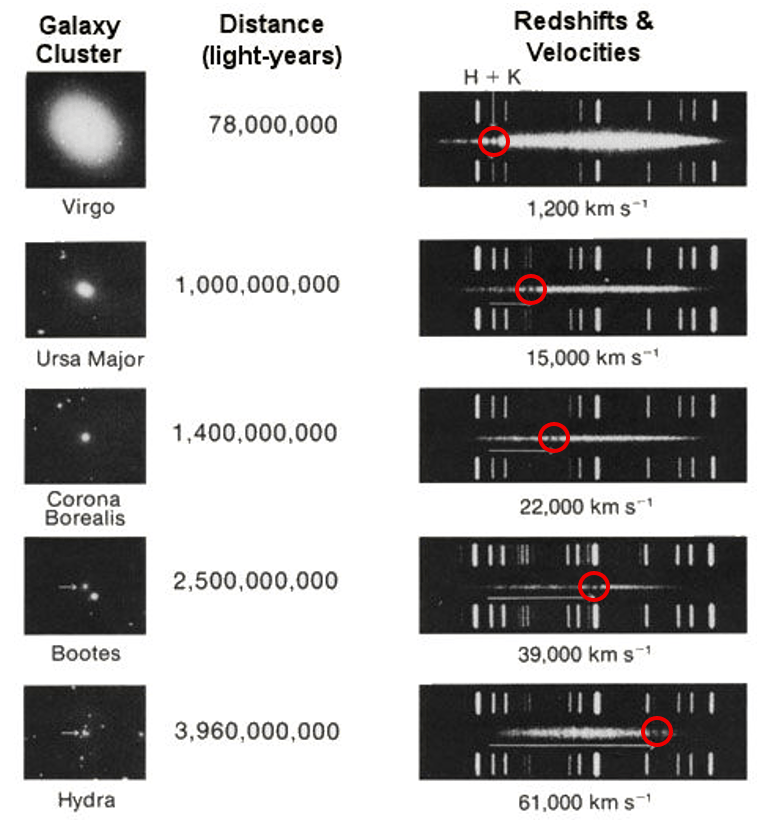
Hubble applied the Doppler effect to objects in space by building on previous work by Vesto Slipher and further observations by his own assistant, Milton Humason. When Hubble analysed the spectra of distant objects, he found their prominent absorption lines (the calcium H and K lines) were shifted towards the red end of the spectrum in comparison with laboratory spectra – hence the name “red-shift”. He also noticed that this effect was greater for objects that were more distant. This is illustrated below for distances up to 3.96 billion light-years. (Hubble’s initial work was limited to a much smaller range of distances: the maximum shown in Plate VIII of his 1936 book, The Realm of the Nebulae, was just 135 million light-years.)
Using reasoning from the Doppler effect, the logic then goes like this…
the greater the red-shift, the faster the object is moving away from us and we have observed that faster-moving objects are located farther away (from us) than slower-moving objects, so if we were to run time backwards, everything would come together at the same point at the same moment, which we could call “time zero”.
This chain of thought gave rise to the idea of the Big Bang as the event that happened at “time zero” and caused the Universe to start expanding.
All of this sounds very neat but it needs qualification. For one thing, Georges Lemaître imagined a Big Bang start to the Universe before Hubble’s results provided the evidence. Even more importantly, it is the space within the Universe, not the Universe itself, that is expanding. This sounds a bit weird but it’s really important.
If the Universe were expanding, we would be entitled to ask questions about the volume into which this expansion is taking place. But if space itself is expanding, there doesn’t have to be anything “outside” the Universe to accommodate its expansion. Instead, every unit of length inside the Universe is constantly increasing in size.
You can think of this as a centimetre becoming 11 mm at a later moment in time. This change would be undetectable because every mark on every measurement scale would also be getting bigger, so a one-centimetre length would become 11 mm (when compared to its size at a previous moment in time) despite still being marked as 10 mm.
The key bits of mathematics needed to support these ideas for the A-level Physics syllabus are as follows;
- The amount of red-shift depends on the ratio of the object’s velocity to the speed of light. We call this “z”, where z = v/c. The effect of red-shift is proportional to the wavelength being measured: it is a constant fraction, not a constant amount. Therefore, absorption lines that have a longer wavelength will be shifted by a greater amount for the same object velocity.

- Hubble’s law says the recessional velocity for any object in space is directly proportional to its distance from the Earth. (There is nothing special about the position of the Earth in the Universe: it just happens to be the location where the measurements are made.) The constant of proportionality, known as the Hubble constant, has a value of about 70 km s–1 Mpc–1. In other words, for every million parsecs of distance, a receding object’s speed will increase by 70 km s–1.

It is important to note that the different techniques used to measure the Hubble constant give slightly different values. This is a small effect but it shouldn’t happen at all so the glitch now has its own name; Hubble Tension.
Regardless of its “true” value, the Hubble constant can be used to calculate the age of the Universe using logic based on the simple relationship; time taken = distance travelled divided by speed of motion.

In order to do the calculation, it is necessary to convert the two distances (km and Mpc) into the same unit.

Converted to more familiar units, this makes the age of the Universe about 13.9 billion years, which is roughly in keeping with the current accepted figure of 13.8 billion years.
So we know the age of the Universe and we know it is expanding: will that expansion go on forever? Until the late 1990s there were three possible answers to this question;
- Given that the Universe contains a lot of matter, gravitational forces should eventually bring the expansion to a halt. The same gravitational forces would then start pulling everything back towards the centre of mass of the Universe, ending in what is often referred to as the Big Crunch.
- It is also possible that the expansion will slow down but never stop because the energy of expansion is greater than the gravitational potential. In this case the matter in the Universe will become increasing diluted, getting colder and colder (strictly speaking, with smaller and smaller temperature variations) until thermodynamic processes cease. This is sometimes called the Big Freeze.
- There is also the possibility of a special case whereby the expansion energy and gravitational potential are exactly equal, in which case the expansion will eventually slow to zero but without any subsequent contraction. In this scenario, the Universe is said to possess critical density.
In 1998, two teams of astronomers, led by Saul Perlmutter and Brian Schmidt, discovered that very distant parts of the Universe appeared to exhibit slower expansion than is measured using nearer objects. Since the most distant objects (known as high-z objects, where z is the amount of red-shift) are being observed as they were a long time ago, this suggests the Universe is expanding quicker now than it has done in that past. That in turn introduces a fourth answer to the question of how the Universe may end: it could be torn apart by ever increasing expansion in what is now termed the Big Rip.
There is more about the discovery of accelerated expansion in the UC Berkeley News Archive, at https://newsarchive.berkeley.edu/news/berkeleyan/1999/0113/science.html, as well as an earlier interview with Alex Filippenko, who revealed the initial results of Brian Schmidt’s High-Z Supernova Search team, at https://newsarchive.berkeley.edu/news/berkeleyan/1998/1202/stars.html.
Whatever the future for the Universe, we have to accept that the simple model based on a constant rate of expansion is incorrect and the Hubble constant varies over extended periods of time. We have a name for the cause of the Universe’s accelerated expansion, Dark Energy, but although we can calculate its amount, we don’t know what it actually is.


2 thoughts on “Red-Shift and the Age of the Universe”