When Edwin Hubble first used data to determine whether “nebulae” were part of our own galaxy, he found they were in fact moving away from the Milky Way at a rate proportional to their observed distance. The most distant of these objects (now known to be galaxies) were receding at the greatest speed.
This in turn gave birth to the Hubble constant as a value that links a galaxy’s distance with its recessional velocity. Hubble’s original value was very different from today’s figure but the interdependence between distance and recessional velocity provided strong support for the Universe beginning with an event described by the Big Bang theory.
At least, that was the case until 1998, when two independent teams of astronomers found the Universe seems to have expanded slower in the past than is the case now. The “force” driving the acceleration in expansion was named “dark energy”, not because it had actually been discovered (being “dark” it’s impossible to see directly) but because something fitting its description is needed to explain the observed acceleration.
All of this has been covered in some detail previously (see https://physbang.com/2026/04/26/red-shift-and-the-age-of-the-universe/).
Recently, things got even more messy. Just as the Hubble constant turned out not to have a fixed value, so it now appears that the effect of dark energy may not be constant either. In particular, it is possible that dark energy becomes weaker over time. As a consequence, the accelerating expansion of the Universe may slow-down and could even halt then reverse. This marks a major change of thinking as the possibility of a “big crunch” was thrown-out with the discovery of the Universe’s accelerating expansion, to be replaced with a “big rip” where the Universe becomes torn apart. Now it seems the big crunch could still be an option.
All of this comes from a five-year project undertaken using DESI, the Dark Energy Spectroscopic Instrument, which has just finished mapping more than 47 million galaxies and quasars (ultra-bright objects that outshine entire galaxies). Only the first three years of data has been analysed so far but already something important has emerged.
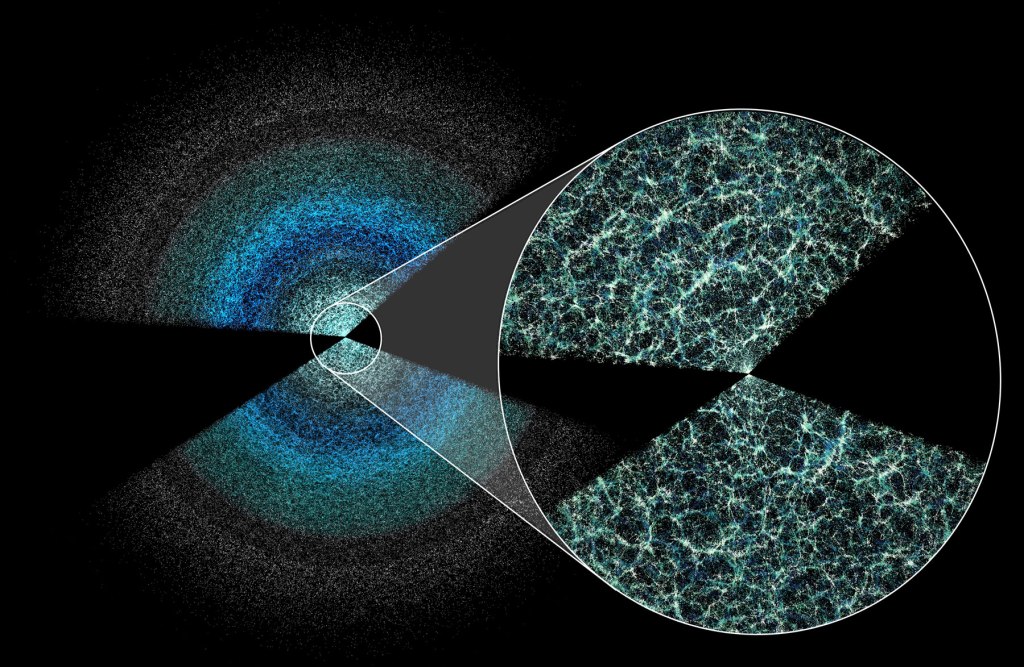
By revealing the extent to which galaxies are clustered together at different distances from Earth (corresponding to different times since the beginning of the Universe) DESI’s data suggest that the effect of dark energy may vary.
This is important because models based on a finite Universe containing any amount of mass allow for the possibility that everything will be drawn together under the influence of gravitational attraction at some point in time. To make matters worse, it would also make a static Universe (which was once assumed to be the case) impossible. So to counter this problem, theorists invoke a “cosmological constant”, referred to as lambda (Λ), that resists gravitational collapse. This “tweak” was first proposed by Albert Einstein although he later removed it from his equations and is said to have described the removal as his greatest blunder.
Although it is part of the widely-respected lambda-cold-dark-matter (ΛCDM) cosmological model, there was no direct evidence for anything that could explain a cosmological constant until dark energy was invoked to drive the accelerating Universe. Now it seems the cosmological constant, which is actually a term in an equation rather than a single parameter and is attributed to vacuum energy density, may not be invariant after all.
That said, DESI’s data do not prove beyond reasonable doubt that dark energy is varying. But there is still another two years of existing data to be analysed (expected to be finished by 2027) AND the instrument’s service life has been extended (until 2028) so even more data will be collected. Confidence in the results will therefore improve in the future, either confirming that dark energy is indeed “evolving” or revealing that the current interpretation is flawed.
There is more information on the official DESI website at https://www.desi.lbl.gov/ and in an excellent article published by Quanta Magazine at https://www.quantamagazine.org/is-dark-energy-getting-weaker-new-evidence-strengthens-the-case-20250319/.


