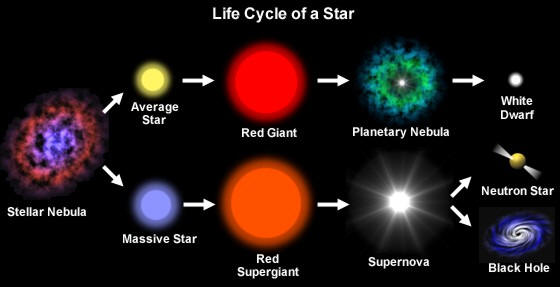
All stars are born through the same basic mechanism but their evolution depends on their size. In particular, all stars go through a hydrogen-fuel stage but the time spent fusing hydrogen is determined by the star’s initial mass. The final fate of a star is also predicted by its mass; some stars will simply fade away whereas others depart in a spectacular supernova explosion that will leave behind either a neutron star or a black hole.
The two main paths for star evolution are shown in the diagram below.
Stars with a mass similar to that of the Sun have a total lifespan of about 10 billion years. Lower-mass stars have much longer lifespans and are likely to be first-generation stars that formed soon after the Universe first came into existence. Conversely, the highest-mass stars, up to as much as 100 solar masses, exist for only millions, rather than billions, of years and their demise will have provided some of the starting materials for the solar systems that surround longer-lived stars, such as our own Sun.
A brief summary of the major types of stars is available on the NASA website at https://science.nasa.gov/universe/stars/types/ and a more detailed downloadable booklet is available from the European Space Agency’s education website at https://cesar.esa.int/upload/201801/stellarevolution_booklet_v2.pdf.
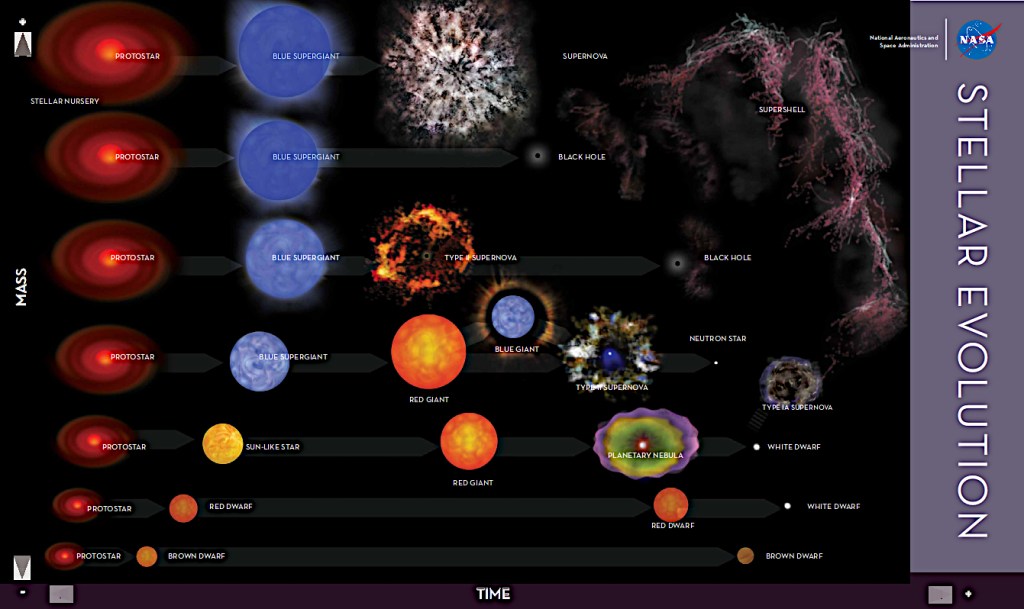
All of this is very simplistic: there is in fact a gradual change in behaviour, not a sharp transition, for stars with different masses. A more detailed diagram is shown below.
Stars are created in deep space from “clumps” of gas and dust that have very slightly higher gravitational fields than the surrounding material and therefore slowly pull more and more material towards the higher-density region. The kinetic energy that is gained as material “falls” towards the clump is subsequently transferred as heat, causing the temperature of the gas and dust to rise. Eventually, the temperature will be so high (above 15 million kelvin) that hydrogen nuclei, stripped of their electrons, will collide and fuse to form helium. The total mass of the products is slightly less than the total mass of the starting materials and the difference in mass (the mass deficit) is released as energy, causing the star to shine.
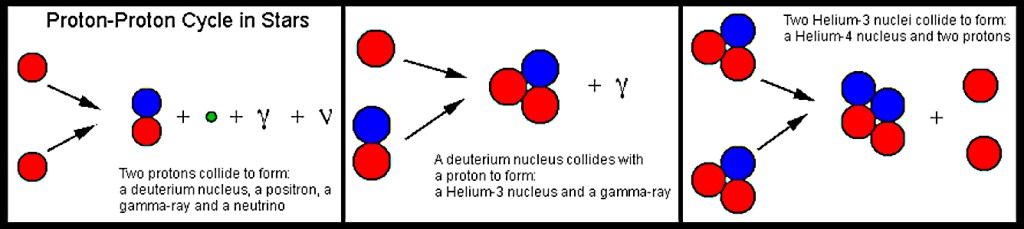
Logically, it would seem to make sense for bigger stars to shine for longer but that isn’t the case because the rate of reaction is faster in higher-mass stars. In all cases, however, the hydrogen fusion process is the same and is known as the proton-proton cycle because it starts and ends with protons, as shown in the diagram below.
As the star’s hydrogen becomes depleted, the outward pressure decreases and the core starts to collapse. This process raises the core temperature sufficiently for helium to undergo fusion, producing carbon and oygen, which in turn increases the star’s diameter, turning the outer surface red. Stars in this phase of their evolution are known as red giants. In the case of our Sun, the expansion will be enough to swallow-up the orbits of mercury and venus – and possibly the Earth too.
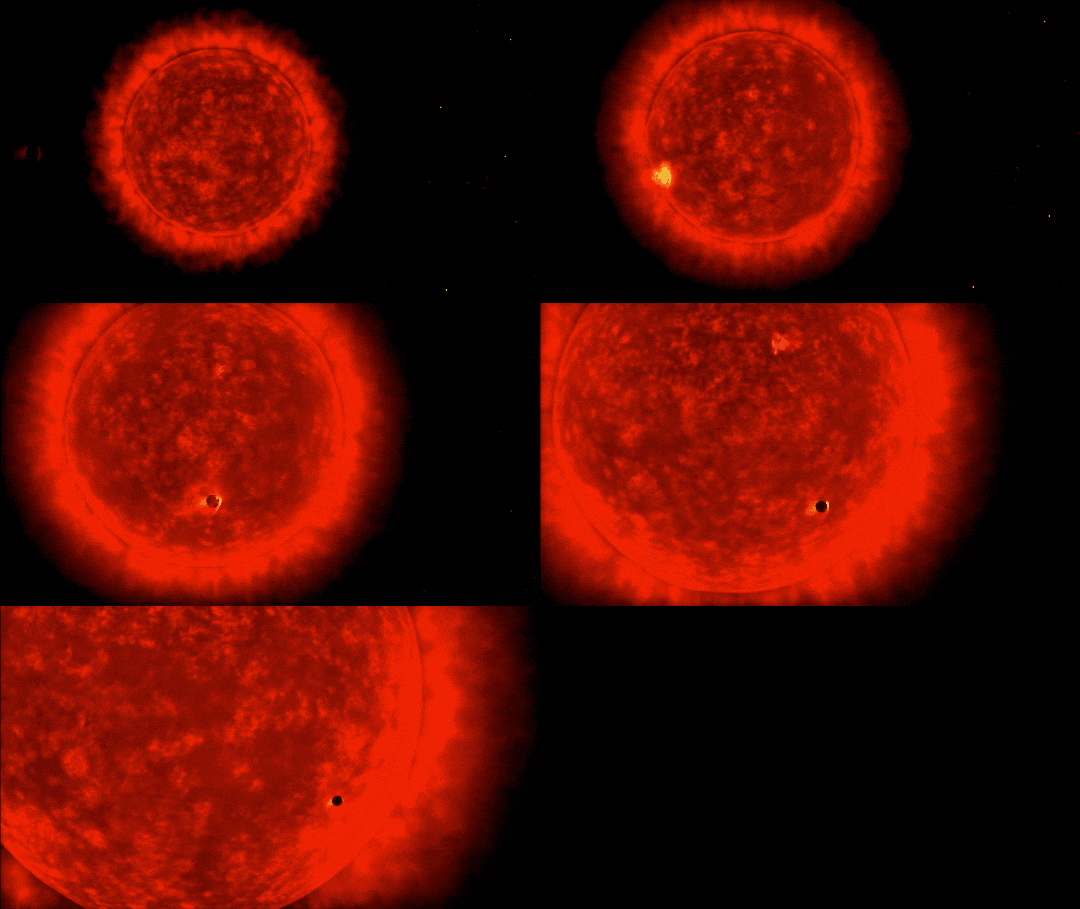
Eventually, even the helium will run-out and stars that are no more than about eight-to-ten solar masses will be unable to fuse any heavier elements. With nothing to resist gravitational attraction, the red giant will collapse into a dense core, shedding its outer layers to form a planetary nebula. (The word “planetary” has nothing to do with planets but refers instead to a nebula surrounding the core at a distance.) The hot, dense core is a white dwarf that will slowly fade and become redder then browner as it cools.
The fate of stars with greater mass is much more dramatic. After fusing hydrogen and helium, the core will collapse again but the temperature will be high enough to overcome stronger electrostatic forces and fusion will continue with heavier (higher proton number) elements. This process can extend all the way to the formation of iron and nickel, which are the most stable nuclei in terms of their binding energies. The heaviest elements will be at the very centre of the star (where the temperatures are highest) and lighter elements will be found further out. Stars that support fusion processes beyond helium are known as red supergiants.
Eventually, as with smaller stars, fusion will cease and the core will collapse but with such enormous power that protons and electrons will become combined as neutrons, in a form of “reverse beta decay”, to produce an ultra-dense neutron star. The high density is easy to explain: in normal atoms most of the volume is empty space between the proton nucleus and the orbiting electrons but once the electrons and protons have combined there is no empty space left, just a tightly-packed mass of neutrons.
The diameter of an atom is about 100,000 times the diameter of a nucleus so a “pure nucleus” material would be a hundred-thousandth of the size of normal matter. To put this into perspective, the Sun has a mean diameter of about a million kilometres but this would reduce to about 10 km if the “empty space” contained in every atom were removed. In other words, if the Sun were converted into a neutron star it would fit into the distance between Buckingham Palace and Kew Gardens in London.
To clarify my analogy, the star’s original mass needs to be more than 10 solar masses but much of the original material will be lost through another process (see below) and only a smaller amount, which could be equivalent to the mass of our Sun, gets condensed into the neutron core.
The implosion that causes neutron formation generates a shockwave that rebounds from the core and explodes outwards, expelling the outer layers of the red supergiant in a high-energy event known as a Type 2 Supernova. The explosion lasts for a matter of hours and is accompanied by an exceptionally bright burst of light (and neutrinos, liberated as a result of electron-proton combinations) that gradually dims over a period of months. There is no planetary nebula formed because the force of the explosion is so great that the outer layers are thrown off into deep space, as shown in the brief animation below.
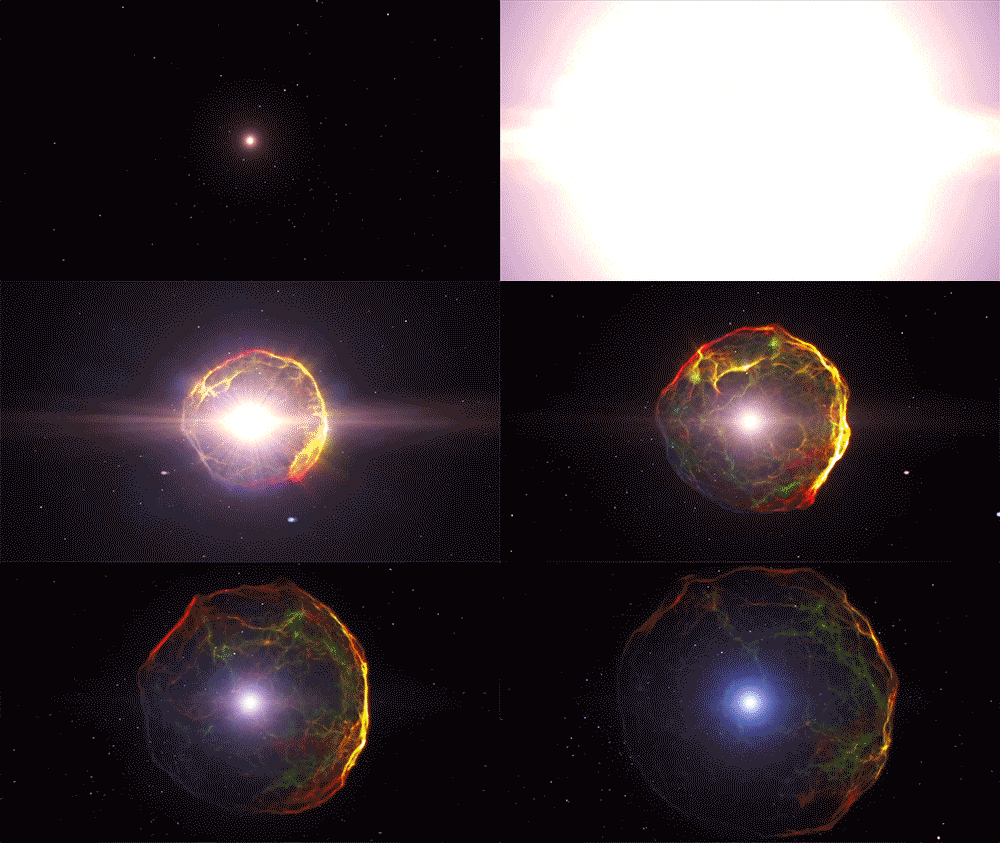
Finally, we have the case of stars that are even more massive, typically 20 to 100 solar masses. In these cases, the processes are similar to those for producing a neutron star via a Type 2 Supernova but the density of the core is even greater – we could even say that it is infinitely dense. This type of object is a black hole, so named because the gravitational field is so strong that even light cannot escape it.
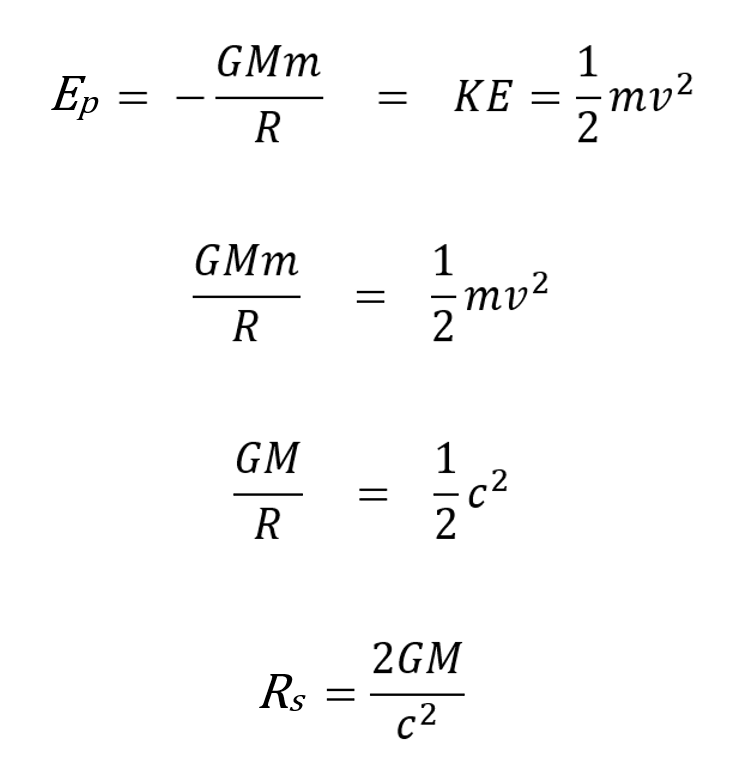
One way to explain this is to say that the escape velocity needed to break away from a black hole’s gravitational field exceeds the speed of light. Escape velocity increases with decreasing distance from a gravitational object and can be calculated by equating the object’s kinetic energy with the potential of the gravitational field.
If the escape velocity at a certain distance is equal to the speed of light, then at all closer distances light will be trapped within the gravitational field. The critical distance is known as the Schwarzschild radius and the location of that distance is called the event horizon because nothing can be seen beyond it due to the fact that no light can escape from within.
The A-level Physics syllabus offers a quick way to calculate the Schwarzschild radius for a given core mass by using the escape velocity calculation outlined above. We will ignore the fact that light (a photon) has zero rest mass, and therefore classical kinetic energy is not applicable, because the result is correct even though the logic presented here is questionable.
The correct method to determine the Schwarzschild radius uses Painlevé-Gullstrand coordinates. This is WAY beyond the A-level Physics syllabus but interested readers may wish to look at some of the documents in the Relativity section of the physicspages website (https://physicspages.com/). In particular, see https://physicspages.com/pdf/Relativity/Escape%20velocity%20near%20an%20event%20horizon.pdf. There is also some great information, provided on a much more accessible level, in James Riordon’s new book Crush: Close Encounters with Gravity, which I thoroughly recommend.
As a footnote, it is important to realise that our knowledge of star formation and star evolution depends on what we are able to observe when we look up into the night sky. In particular, the idea that all stars begin as clumps of dust and gas is impossible to comfirm with the naked eye and remains difficult even with powerful telescopes if we confine ourselves to visible light.
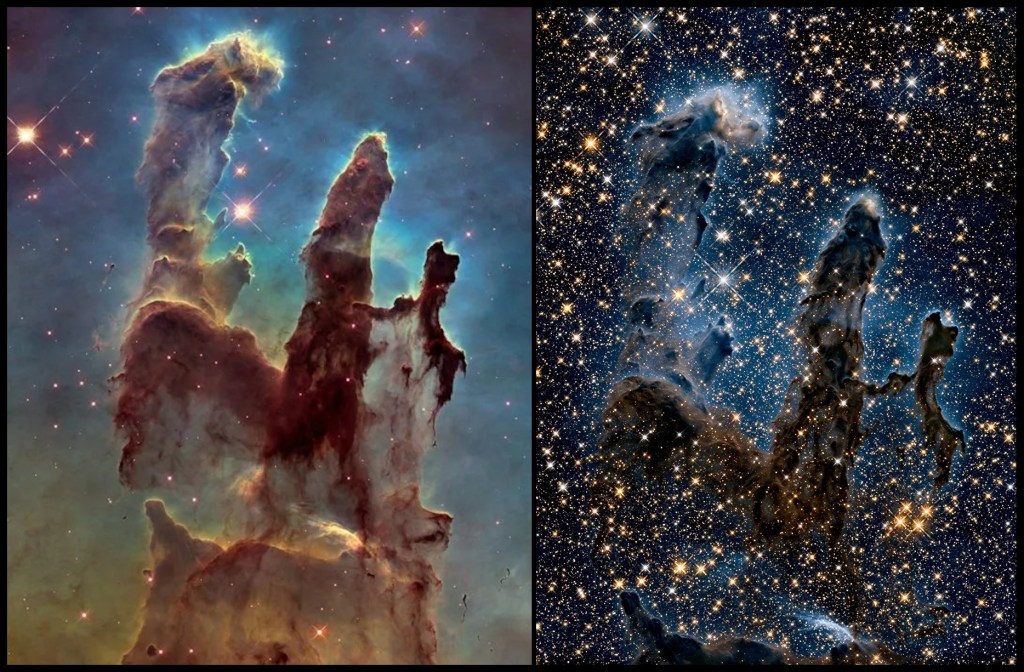
The problem is that the “clumps” are irregularities within larger clouds that are opaque to visible light. Fortunately, infra-red radiation is able to penetrate through the clouds, revealing the stellar nurseries that exist inside. The images below, taken by the Hubble Space Telescope using visible-light and infra-red cameras, highlight the massive advantage that infra-red imaging has brought to astronomy.