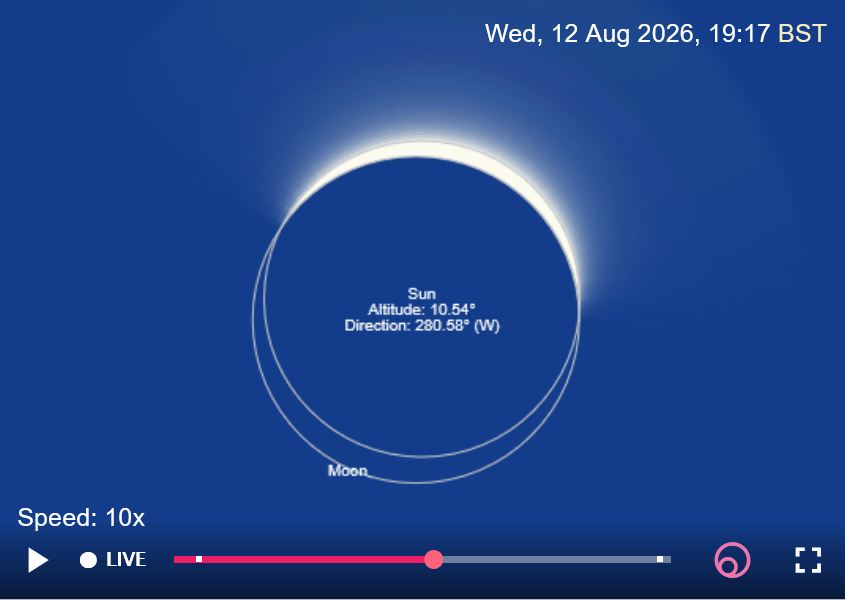
Next Wednesday, 12th August 2026, a full solar eclipse will be visible from Iceland and Greenland in the north, together with Spain and the very north-eastern tip of Portugal in the south. In Jersey, the eclipse will cover more than 90 percent of the Sun’s surface at around 7:15pm. Weather permitting, it should be quite a spectacular sight.
Much of what follows here comes from a recent column I wrote for the Jersey Evening Post, where I noted that the ability to predict future events with such certainty is a tribute to the power of science, particularly physics and astronomy (JEP, 6th August 2026).
Although there are records of eclipses having been observed for thousands of years, describing an event is very different from predicting where and when it will occur in the future. The Babylonians and the Greeks knew there was a pattern of eclipses based on 223 lunar cycles, which equates to about 18 years: these are known as Saros cycles (see https://eclipse.gsfc.nasa.gov/SEsaros/SEsaroscat.html for more details) but there are multiple Saros cycles running at any one time so predictions weren’t very precise.
It wasn’t until 1715 that Edmund Halley, who is most famous for the comet named after him, made the first accurate prediction of a future solar eclipse. Halley had a vested interest in getting the details right as that year’s path of totality (full solar eclipse) was expected to pass right over his house in London. His prediction turned out to be accurate to within four minutes of time and 20 miles of distance, leading to even better predictions thereafter.
Retrospectively, eclipses have been associated with major historical events; the darkness that spread over the land at Christ’s execution has been linked to an eclipse, as has the death of Mohammad’s son Ibrahim. Unsurprisingly, therefore, some people regard an eclipse as a time for prayer. But whether you regard such events as being religiously significant or not, eclipses are always a time for awe and wonder.
Importantly and despite most of the Sun being obscured next Wednesday, it will not be safe to look directly at the eclipse, even wearing conventional sunglasses. Similarly, attempting to take a photograph by zooming-in on a smartphone or digital camera could result in the sensor being damaged by the intensity of the light.
The only safe way to observe a solar eclipse is through glasses that are specially designed for that purpose. And the only way to take a photograph is by holding (or fitting) an appropriate filter in front of the lens.
If you intend to view or take pictures of next week’s eclipse then it makes sense to scout for a location in advance, bearing in mind that the maximum extent will be at around 7:15pm when the Sun is only about 10 degrees above the horizon.
Although most people look skywards, partial eclipses also create distinctive crescent-shaped patterns on the ground that are much safer to photograph. The illustration shown below is one such picture that I took in 1999, when Jersey had its own total eclipse but I was working in London so a partial eclipse was the best I could see.
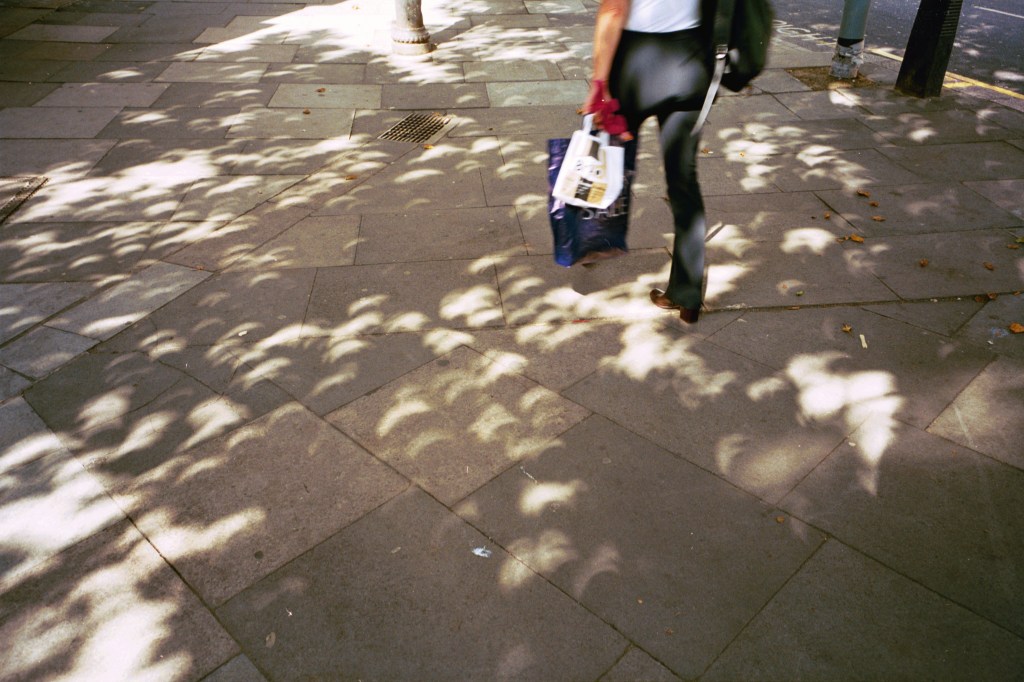
The reason why crescents are seen on the ground isn’t necessarily obvious but an equivalent effect can be observed by standing under a tree canopy on any cloudless day, when some of the bright patches on the ground will look circular. The gaps between the leaves overhead have irregular shapes so it may seem strange that there are round highlights on the ground.
The explanation resides in the fact that some of the gaps between the leaves can be so small they behave like apertures in a pinhole camera, projecting an image of the light source on the ground rather than creating a “shadow” of their own shape. The image they project is that of the Sun’s disk and that is why the highlights (anti-shadows, if you like) are circular. I wrote about this effect in a bit more detail a couple of years ago in a post that is available at https://physbang.com/2023/07/20/shapes-of-shadows/.
The natural effect from tree leaves won’t be obvious next week because the Sun will be at a very low angle but there will be an opportunity to create the effect deliberately. Just use a sharp pencil to make a small hole (approximately 5 mm) in the middle of a large sheet of card and hold the card a few metres away from a plain wall, facing the Sun. The image that is seen on the wall will reveal the eclipse in a way that is very safe to observe. A larger hole will make the image more obvious but also less distinct, so there is an opportunity for experimentation to find the optimum conditions.
Conducting the experiment indoors, using a west-facing window with a low view of the horizon, should improve image contrast enormously, especially if the curtains are closed right up to the cardboard sheet (but not blocking the hole, of course).
However you decide to view next week’s partial eclipse, my top tip is to do a dummy-run in advance to decide where and how you want to observe this fantastic phenomenon. It may also be helpful to watch an animation so you know what to expect (see caption below).