
Exam season is over so this seems like a good time to admit that physicists don’t know all the answers – and don’t even always agree on which of the available answers is best. The two biggest areas of disagreement are cosmology and quantum mechanics. For example;
- What do we mean by the “Big Bang”?
- What is the cause of the Hubble tension?
- What is the best interpretation of quantum mechanics?
Everybody is entitled to a view on such matters but to determine the general consensus Physics Magazine ran a 10-question poll, The Big Mysteries Survey, between the end of July and the beginning of September last year (2025). More than 1600 replies were collected and analysed. The questions are still live so you can add your own responses, if you wish, at https://apsphysics.fillout.com/t/nXpw5x5CnPus.
So what were the findings? In some cases there were clearly-favoured answers but “physicists are more divided on many foundational questions than popular accounts often imply”. That is the conclusion given at the end of the original paper (see link below) which also notes; “several positions frequently presented as settled or near-consensus views do not command majority support in this dataset”.
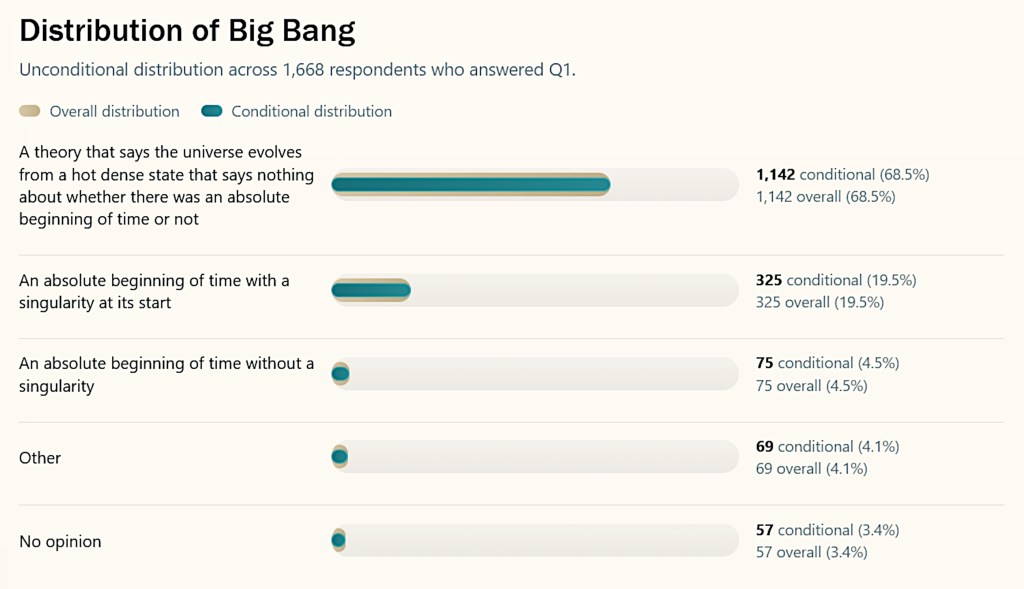
Interpreting the meaning of the Big Bang was relatively straightforward, as was explaining the uniformity of the Universe (cosmic inflation being favoured by 51% of respondents) but there was no consensus on the cause of the Hubble tension, which arises because different measurement methods give different values for the rate of expansion of the Universe. The commonest response was effectively “don’t know” (24%) although in a previous, much smaller, survey the most popular explanation favoured systematic errors in supernova data (see https://arxiv.org/pdf/2503.15776).
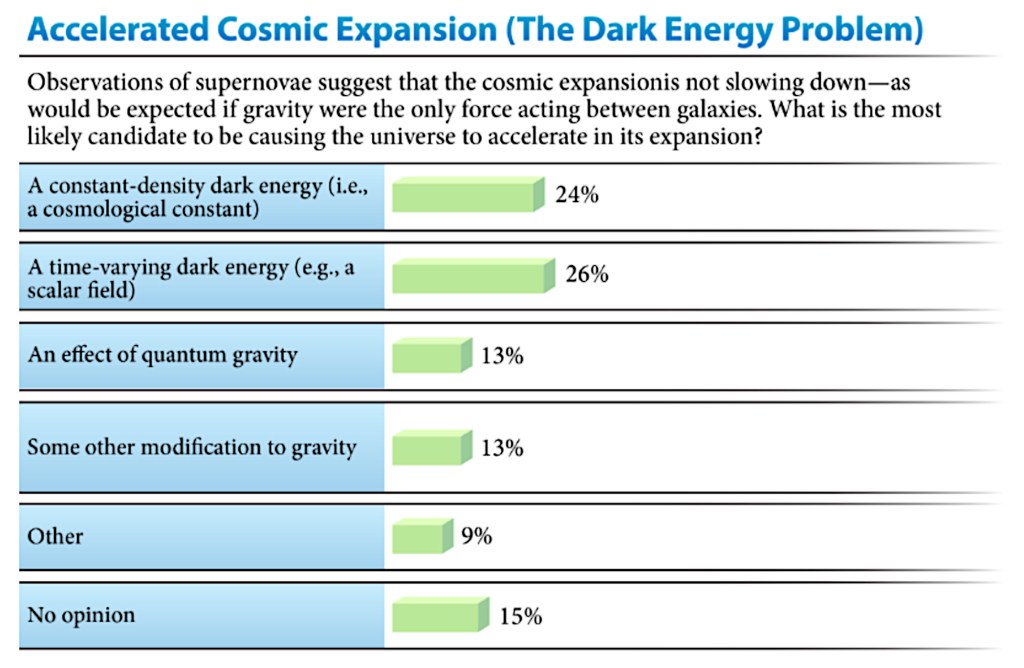
The nature of dark energy proved difficult to pin-down (see illustration below) as did the nature of dark matter – but modified Newtonian gravity, which would avoid the need for any form of dark matter, was poorly supported (12%).
There was a clear favourite choice (although not a majority view) on the real-world meaning of quantum mechanics, with 36% opting for the Copenhagen Interpretation, which boils down to accepting the mathematics even if we don’t understand the reality.
The least tangible of the questions asked about “anthropic coincidences”, where the values of many fundamental constants exist independent of scientific theories. It has been suggested that if these values were different, life might not have emerged in the Universe. The big question is; are the life-friendly values of fundamental constants mere coincidence or is there some design in a Universe that makes life possible?
Only nine percent of respondents support the Universe being the result of intelligent design. The most popular stance (26 %) accepts the values as they are, with no further explanation required.
Further reading
The results of the 2025 poll are discussed at length on the American Physical Society website at https://physics.aps.org/articles/v19/34 and the original paper can be downloaded from https://arxiv.org/pdf/2605.11058. Lead author Niayesh Afshordi’s interactive analysis tool is available online at https://nafshordi.github.io/aps-dashboard/, where there are also links to other resources related to The Big Mysteries Survey.


