
When answering examination questions, it is important that your excellent knowledge of physics isn’t undermined by your calculator behaving in an unexpected way. You MUST be able to trust the answer given. But the situation is potentially complicated, not only because calculators don’t all behave the same way but also because they may not even be behaving the way you expect.
First consider a very simple calculation;
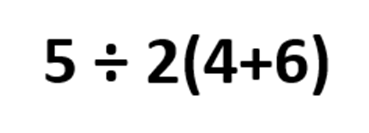
What do you expect the answer to be?
You might decide to divide five by two lots of four-plus-six, or 5/20, giving 0.25. But this isn’t correct in strict mathematical terms because there is an implied multiplication between the 2 and the opening-bracket, so the calculation can be rewritten as;
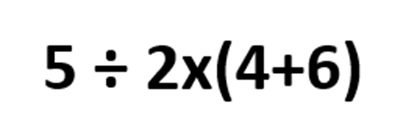
The priority given to different mathematical operators is; brackets, indices, division, multiplication, addition, subtraction (BIDMAS) and using this ranking the steps are;
- calculate the expression in brackets by adding four and six (10)
- divide two into five (2.5)
- then multiply the two earlier results (giving 25)
When computed this way, the answer is very different from the first value calculated.
Importantly, either 0.25 or 25 can be displayed by a calculator, depending on how each individual device has been programmed, so it’s important to know which approach is taken by YOUR calculator when tackling problems that aren’t as easy to check intuitively.
For the record, my Casio calculator, which I have used very successfully for many years, gives the answer as 0.25, which is wrong. But that’s not a problem because I add extra brackets when carrying out calculations to ensure that each step is completed as I intend.
For the sake of clarity, it’s wrong to write a calculation in the first arrangement shown above if you mean that five is to be divided by everything else. Modern calculators that have a fraction mode, where the numerator and denominator are entered explicitly, help to avoid such ambiguities. Similarly, some calculators automatically insert extra brackets to indicate how the calculation is being conducted, which is helpful, and the scientific calculator on my step-daughter’s iPhone adds the implied multiplication sign, again clarifying the process being used.

The previous example was entirely abstract so a more meaningful calculation might serve to highlight this particular problem more clearly in the context of real physics.
Suppose we had to calculate the closest approach of a 5 MeV alpha particle that travels towards a gold nucleus. The solution involves finding the distance at which the maximum electric potential is equal to the initial kinetic energy.

- The values of q1 and q2 are twice the electron charge and 79 times the electron charge (1.6 x 10⁻¹⁹ C)
- The kinetic energy is five million electron-volts, which needs to be converted into joules
- The value of the permittivity of free space is 8.85 x 10⁻¹² F m–1
When these values are calculated correctly, the answer is 4.5 x 10⁻¹⁴ m.
That answer sounds about right bearing in mind the radius of an atomic nucleus is a few femtometres (10–15 m) and in this situation there are two nuclei with a finite separation between them. If you got any other answer then you should review your calculation method as you may not be instructing your calculator in a sufficiently exact way.
As mentioned earlier, adding brackets to isolate different parts of the calculation is always a good idea and takes very little effort to help guarantee the right answer.


