
In the previous discussion about lumens (https://physbang.com/2025/12/30/what-are-lumens/) some numbers were quoted without any explanation. This post adds a bit more detail to those numbers.
Firstly, the maximum theoretical output of a light source was stated to be 683 lumens-per-watt. Why that number?
The answer is to be found in the definition of the candela, which is defined as a source that radiates 1/683 watts per steradian. The candela in turn defines the lumen in the same way: a candela is equal to one lumen per steradian. Therefore, the terms “one lumen” and “1/683 watts” must be the same, meaning that one watt must be equal to 683 lumens. So the greatest luminous flux that can be achieved from 1 W of electrical power is 683 lumens, making the maximum theoretical output of a light source equal to 683 lumens-per-watt.
But this doesn’t explain the origin of the number 683 (or 1/683) when defining the candela in terms of watts. The more basic answer is to be found in a historical desire to maintain some compatibility between the SI unit and previous non-SI units. In particular, the candela was defined to give a brightness comparable with that of a standard candle, known as one candlepower.
Note the term “standard candle” has a specific meaning in astrophysics but here simply means a particular wax-based light source. To be exact, the UK definition of one candlepower was the light radiated by a sperm-whale-wax candle of mass 76 g burning at a rate of 7.8 g per hour. (Obviously, the grams are equivalent masses as Nineteenth Century Britain was decidedly un-metric!)
This definition was subsequently updated in terms of the light emitted by a given amount of solidifying platinum but that too was specified in a way to make it more-or-less consistent with the light from standard wax candles.
The 683 lumens-per-watt value is therefore entirely empirical (experimentally based) and was not derived from any theoretical model. For more details, see the entry on Wikipedia (https://en.wikipedia.org/wiki/Candlepower) and the US National Institute of Standards and Technology website (https://www.nist.gov/si-redefinition/candela).
The other numerical reference that needs more detail is the sensitivity of the human eye, as the definition of the candela refers to a specific frequency of 540 THz as the peak of visual perception. I mentioned previously that human spectral sensitivity is “typically given as about 380 – 760 nm” and deliberately avoiding discussing the various figures that are quoted in different sources.
For detailed data about the bright-light (photopic) spectral luminous efficiency of human vision, the definitive source is the International Commission on Illumination (CIE). In particular, one of the CIE’s webpages has a public data-set for human visual sensitivity from 360 nm to 830 nm (https://cie.co.at/datatable/cie-spectral-luminous-efficiency-photopic-vision). The 555 nm peak is given a value of 1 and the extreme limits go down to 3.92 x 10⁻⁶ (at 360 nm) and 4.52 x 10⁻⁷ (at 830 nm). Trying to fix the range of human visual perception amounts to deciding on the level of sensitivity that is so low as to be effectively zero.
As the graph below shows, a reasonable range would be about 420 nm to 700 nm (both of which have relative sensitivity values of about 0.004) but you might feel other values would be more appropriate. You can download the data set and do your own analysis if you are so inclined.
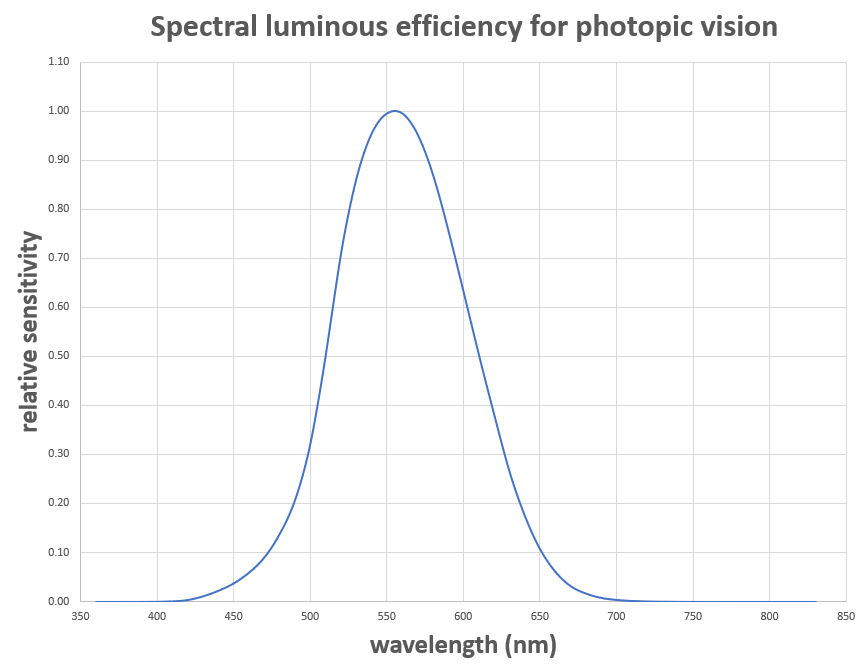
In closing, it is worth noting that the spectral curve shown above applies specifically to bright-light conditions, when the human eye’s cone sensors are active. Under lower-light conditions, the retina’s rod sensors are active and the applicable term is scotopic vision. The RP-Photonics website, mentioned in the previous post, has a good discussion of this (https://www.rp-photonics.com/scotopic_and_photopic_vision.html) and there is a nice series of freely-available online illustrations that simulate the effects, linked to the book Sensation and Perception by Bennett Schwartz and John H. Krantz (https://isle.hanover.edu/Ch03Eye/Ch03PhotopicScotopic.html).


