
Newton’s Second Law of Motion tells us that the force required to accelerate an object can be calculated by multiplying the mass of the object by the acceleration that is required (F=ma). We also know that acceleration is simply the rate of change of velocity (the change in velocity divided by the time taken for that change to occur).
We can combine these two equations to give a new equation, as shown below;
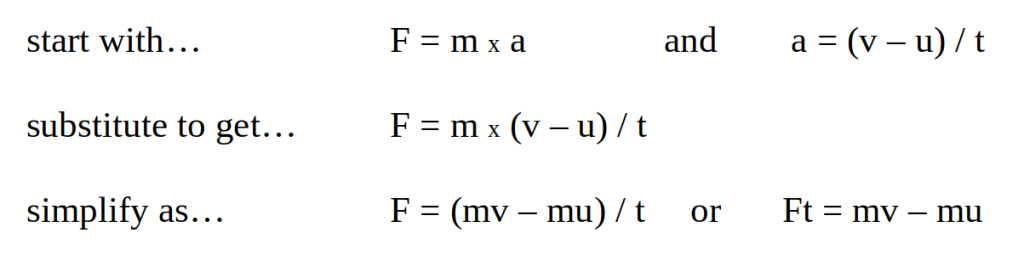
This is not just random algebra. It turns out that multiplying an object’s mass by its velocity gives us a new quantity, known as momentum, which is designated by the symbol p (not least because m has already been used for mass). The unit of momentum is the same as the unit for mass multiplied by the unit for velocity, giving kg m/s. This is said exactly as it is written, “kilogram metres per second”.

Note that v in the above equation indicates any velocity and we often add subscripts to indicate the starting velocity and the final velocity (rather than using u and v respectively). Incidentally, but not required for the GCSE course, it turns out that the product of force and time (Ft) is also a new quantity, known as impulse (which does not have its own symbol) with units of newton-seconds.
Momentum is important because it is a conserved vector quantity. This means the total momentum before an event is always equal to the total momentum after that event. When two objects collide, the conservation of momentum makes it possible to predict the subsequent motion of both objects based on their initial velocities (speeds and directions) and their masses.
Note that energy is not conserved between two bodies that collide as some energy may be dissipated as heat or sound, so energy balances cannot be used to make deductions about the behaviour of colliding objects. (Collision events are at the heart of particle physics but in our course we will confine ourselves to the everyday world.)
Common examination questions often involve collisions between dynamics trolleys or balls that either stick together or move off separately after colliding. In all cases, the fundamental principle is that the total momentum in a system after a collision has occurred is always equal to the total momentum in the system before the collision.
Let’s look at two examples;
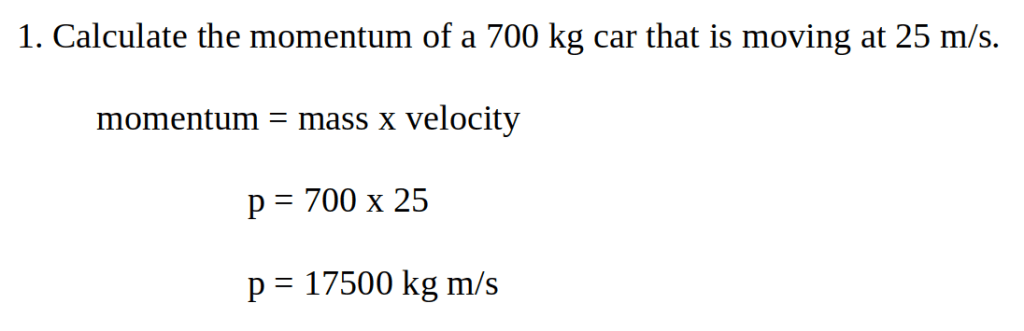
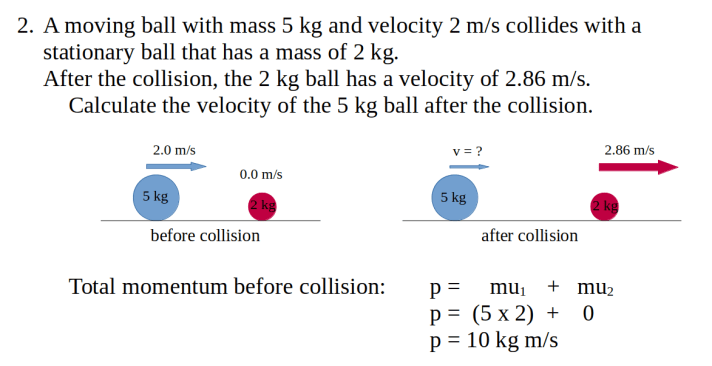
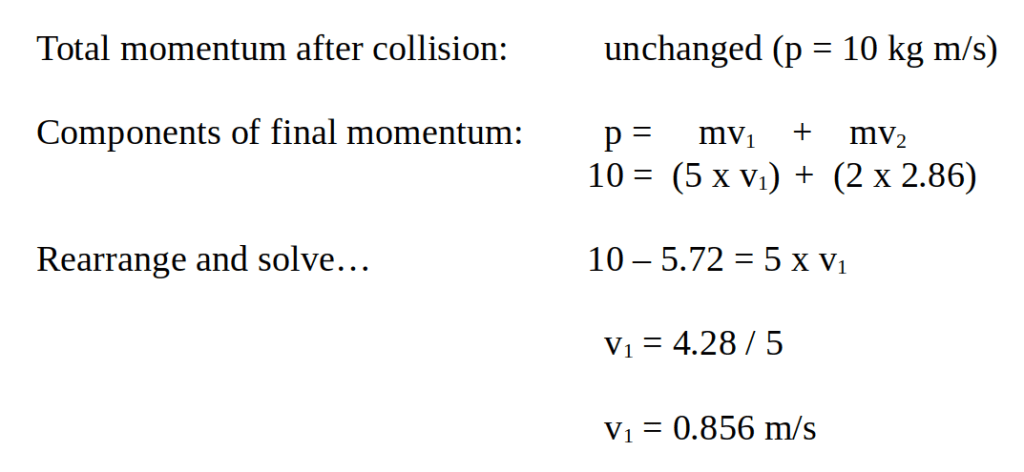
Momentum questions can seem hard because they involve several stages but that also means they will be worth more marks in the examination so it’s worth understanding the equations and methods required. And remember that momentum questions will only appear in the Higher Tier paper.


