
There are various techniques that can be used to investigate the relationship between force, mass and acceleration (Newton’s Second Law of Motion). In a school lab, we often use a dynamics trolley (wheeled platform) that is attached to a mass hanger via a string that runs over a desk pulley. The mass hanger provides the accelerating force as it falls to the ground: adding more mass increases the force in direct proportion to the mass (each additional 0.1 kg increases the force by 1 N).
So much for varying the force: how can we measure the acceleration that is produced? Students in schools that have sophisticated electronic equipment (data-loggers with an immediate read-out for acceleration) will find this practical much easier than others who have to work with simpler equipment and carry out multiple calculations using distance and time measurements.
Although not often suggested, there is a useful intermediate technique that can be used if your light-gates display velocity (speed) rather than acceleration. This method can be used in one of two ways;
- Use the light-gate and a stopwatch. Time how long the trolley takes to reach the light-gate and record this time, together with the speed shown on the light-gate. Repeat the measurements and calculate the acceleration for each run, then work out the mean acceleration. Bearing in mind that the starting velocity was zero, the acceleration is simply the final velocity (displayed on the light-gate) divided by the time taken for the trolley to reach the light-gate. To complete the practical, change the force and go through this same procedure for each value of force that needs to be investigated.
- Use the light-gate and a metre rule. Place the light-gate about a metre from the start position. Measure the exact distance from the leading edge of the card ‘fin’ to the middle of the light-gate. Make sure that the trolley is always released from the same starting line but note that the distance must be measured from the card rather than from the front of the trolley. Calculate the acceleration by dividing the velocity-squared by twice the distance, as explained previously (here). Repeat the measurements, find the mean, then change the applied force and go through the process again.
Both variants of this method are illustrated in the drawing below.
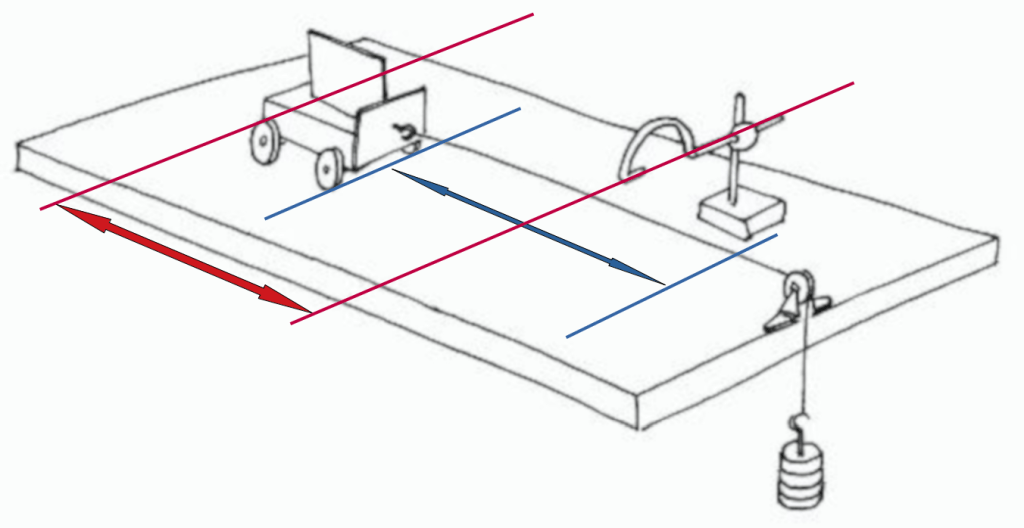
The hardest thing about this technique is releasing the trolley carefully so that the card ‘fin’ goes cleanly through the light-gate. In theory, the string will pull the trolley in a straight line but releasing the trolley at a slight angle will often cause the ‘fin’ to miss the light-gate. You must expect to have to do more runs than planned to allow for the runs that simply “don’t count”!

 Mr Tarrant's physbang 'blog