
In my very last Y11 lesson of last term I did a 15-minute dash through some of the weirder bits of physics, including Heisenberg’s uncertainty principle. This says that, for example, you cannot know the exact values of an object’s position and speed (actually its momentum). More excitingly, you cannot know the exact energy of a system at an exact moment in time.
Heisenberg’s uncertainty principle applies to small-scale (quantum) systems but it raises an interesting real-world issue: is it possible to know the exact speed of any everyday object at a precise point? The problem is that speed is a rate of change of distance, which means the object has to cover a finite distance to have a speed, and therefore the object can’t be at a single location. The short answer is to insert the word “average”; we are usually calculating an average speed for the time period (and distance change) used.
When taking photographs of moving objects, things get even more interesting because the camera itself can affect the image that is recorded. I demonstrated this some years ago by photographing the same car (Lancia Fulvia Zagato) on successive laps at Goodwood race track. On one lap I used the camera (Mamiya M645) normally but on the next lap I turned the camera upside-down. Inside this particular camera, pictures are captured as a shutter moves right-to-left and when the camera is upside-down the shutter effectively runs in the opposite direction. The car always moves in the same direction so what we have is an “observer effect” where the shutter moves either in the same direction as the moving object or in the opposite direction. This has a surprising effect on the pictures taken, as shown in the pair of images below.
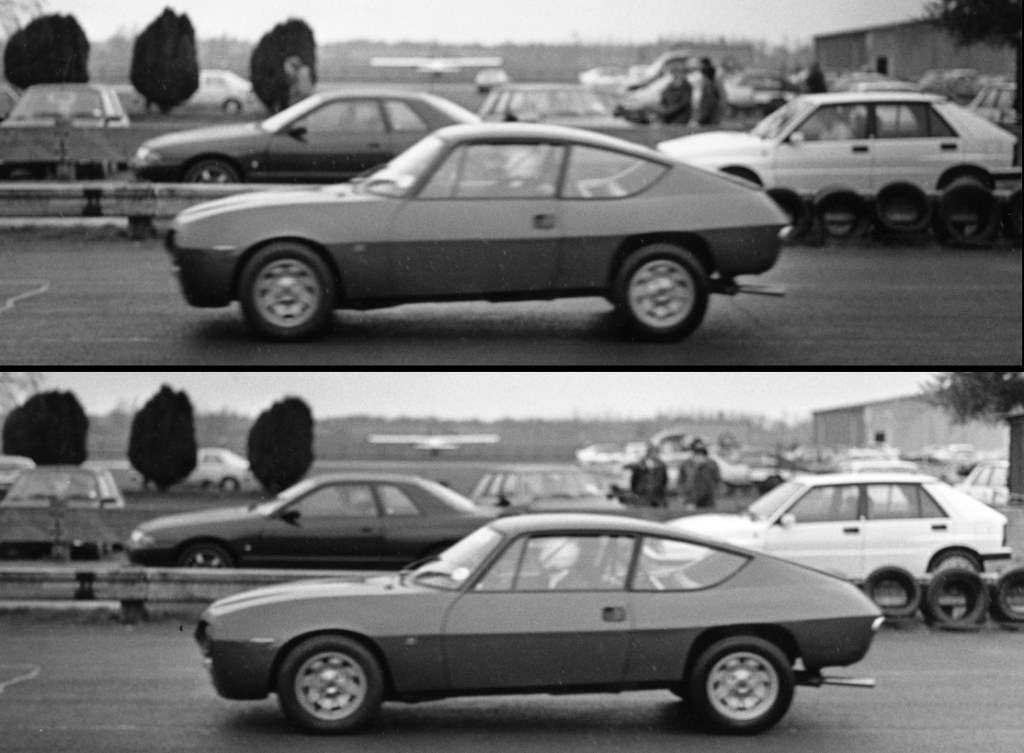
Although it is the same car, the vehicle definitely appears to have different lengths in the two photographs (judged against the positions of the static parts of the pictures). And if you wonder whether the “longer” car could have been closer, look carefully at the track where you should be able to spot a few features that will confirm the car is at (more or less) the same distance from the camera.
In a funny way this is directly comparable with core of Heisenberg’s quantum uncertainty principle, namely the fact that observing an object disturbs that object in some way.
To be fair, I would never have dug out these pictures if I hadn’t been reminded of my last Y11 lesson by a recent episode of The Big Bang Theory, in which Sheldon tells physicist jokes, one of which went something like this;
Heisenberg was driving down the highway when he got pulled over by a traffic cop. “Do you realise that you were doing exactly 86mph?” the officer asks. “Oh no, now I’ve got no idea where I am,” Heisenberg replies.
Who says physics can be fun (phun, maybe)?

 Mr Tarrant's physbang 'blog