No matter where you are in your learning journey, it’s never to early to start “revision”. Why have I put quotation marks around the last word? Because if you “revise” early enough you will be front-loading your learning – and that’s even better than retrospective revision!
Front-loading is sometimes known as flipped learning and it’s the idea that things can be learned before they are taught. In other words, you read about something (and maybe even test yourself on what you’ve read) before the teacher presents that topic. Later on, when you learn about the same material in class, you will already have some idea (maybe even a good idea) of what the topic is all about.
There is no reason why you can’t start reading about GCSE science topics as early as you like. I know there are students in my Y7 and Y8 classes who would easily be capable of starting to understand some of the GCSE content right now – so why not do it?
Of course, if you have already started the GCSE course then you can revise what has previously been covered and front-load content that is yet to come. And at the end of the course, you will need to revise everything. Strictly speaking, revision is about refreshing your memory of things that have already been learned but often it is also about learning the things that weren’t completely understood the first time.
As I’ve pointed out to classes many times over the years, the worst form of revision is simply reading something! I wouldn’t call passive reading a complete waste of time but it’s definitely not very effective.
If you want to make the best use of your revision time then you must do something with the information rather than simply absorbing it. You could make flashcards (again, not really a favourite of mine) or draw mind-maps, which are a much better idea because you have to work out how information is organised and linked.
I highly recommend the excellent mind-map software from Florida’s Institute for Human and Machine Cognition, which you can download and use completely for free on almost all devices (Windows, Linux, iPad and OS-X). Don’t be put off by the heavyweight sounding name of the organisation: Cmap is fantastic software that’s really easy to use. Click here to visit the IHMC website, shown below.

For structured online revision, it’s hard to beat the BBC Bitesize website. The important thing, however, is to make sure that you’re revising content for the correct exam papers! To make life easier, I’ve listed below the direct links to the sections for Biology, Chemistry and Physics in the AQA Trilogy course.
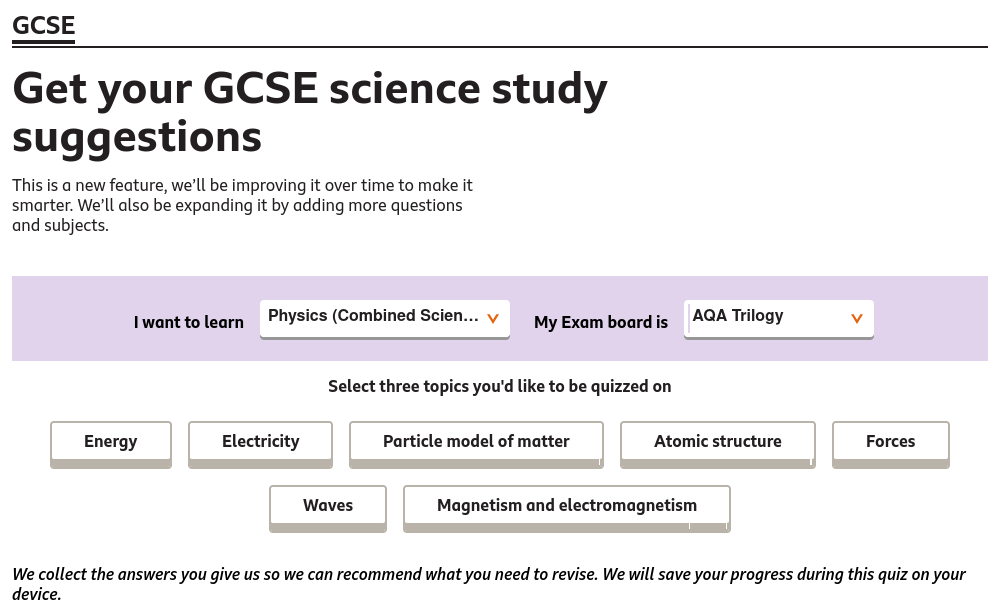
When you arrive on the BBC Bitesize page, you might see a message inviting you to answer a few questions so the website can workout what you most need to revise: this is a really useful feature so don’t skip it! And don’t expect all the questions to be easy. If the message doesn’t appear, you can access this new feature of BBC Bitesize by clicking here. The current version of the starting screen, having selected Physics (Combined Sciences) and AQA Trilogy, is shown below
Effective revision involves a good deal of time and effort but it will be worth it in the end. If you know there are things that you don’t understand, then now is the best time to start trying to address those areas. This applies just as much to those of you in Y10 who still have a lot of the course ahead: if you know that you “didn’t get” some of the bits we went through this term, then use BBC Bitesize to improve your understanding now. And if you’re in Y11, then getting everything under your belt is more important than ever!
Finally, if you’re a younger student who is front-loading learning ahead of starting your GCSEs, then good for you. To paraphrase the message at the top of this article, it’s never to early to start learning.
BBC Bitesize, AQA Trilogy (all content): https://www.bbc.co.uk/bitesize/examspecs/z8r997h
BBC Bitesize, AQA Trilogy Biology: https://www.bbc.co.uk/bitesize/topics/zthssrd
BBC Bitesize, AQA Trilogy Chemistry: https://www.bbc.co.uk/bitesize/topics/z88jjty
BBC Bitesize, AQA Trilogy Physics: https://www.bbc.co.uk/bitesize/topics/zqw77p3

 Mr Tarrant's physbang 'blog