Electric circuits are all about energy transfers: they allow the energy in the original source to be transferred via electricity into some other form. In the classic torch-bulb circuit, for example, chemical energy (in the cells) is converted into electrical energy, which is then converted into light (and heat, for old-fashioned bulbs).
The amount of electrical energy transferred depends on the voltage, which is the energy given to each unit charge. It also depends on the current, which is the rate at which charge flows around the circuit. These two quantities are explained in a separate post, which you can read here.
To get a more hands-on feel for electric circuits, there is a great PhET simulation that you can use to explore electric circuits: you can read about this simulation, and find a link to it, in this post.
Returning to the torch-bulb circuit mentioned at the start of this post, there are two different arrangements that could be used to light two lamps instead of just one. In one arrangement (a series circuit) the lamps are placed one after the other whereas in the other arrangement (a parallel circuit) both lamps have their own direct connection to the power supply. Circuit diagrams for these two arrangements are shown below.
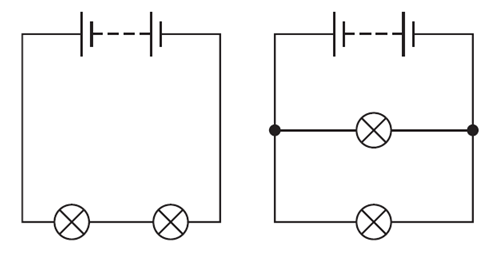
Your task is to use the online simulation to construct these two circuits and explore the potential difference (voltage) and current in different parts of the two arrangements. In particular, you must compare the potential difference across each lamp in the two arrangements and look at how the current changes when a single wire splits into two different branches of the parallel circuit, indicated by the black-dot connection points.
You should also think about the advantages and disadvantages of each type of circuit in terms of how the two lamps work. (HINT: Think about whether it would be a good idea for one lamp to stay on if the other one fails, or whether it would be better to have both lights go out. You might also think about how easy it is to create the two types of circuit.)
To check that you have completed this task correctly, and that you understand the concepts of voltage and current as well as series and parallel circuits, I have created an online worksheet that tests this knowledge. As well as building your simulations (via this post) to take voltage and current measurements, don’t forget to read the voltage and current post (here) before attempting the test!
To access the online test, click here.


Dear Tarrant,
I am writing to thank you for this wonderful blog posts. I have come to learn about this blog through your publication on Science in School journal. I have question about this statement here “chemical energy (in the cells) is converted into electrical energy, which is then converted into light” which deals with the concept of energy. I have understood energy as a quantity which allows us to do calculations. But light intensity which is measured in candela is a rate of energy transfer per unit solid angle. So I am a bit confused about this and would like any explanation.
Thanks,
Ugochukwu
LikeLike
I have been working on a post that looks at the different ways we measure light. Since you have asked about this specific topic, I will prioritise that work and post it shortly.
LikeLike