
Nobody knows whether there is intelligent life elsewhere in the Universe, and some people joke that it may not even exist here on Earth, but it’s still interesting to consider the probability of there being extra-terrestrial life out in space.
The long-established basis for calculating the likelihood of Earthlings detecting radio signals from life elsewhere in our galaxy is the Drake Equation, which was devised way back in 1961 by Dr Frank Drake while he was working at the US National Radio Astronomy Observatory in West Virginia. The equation looks like this;
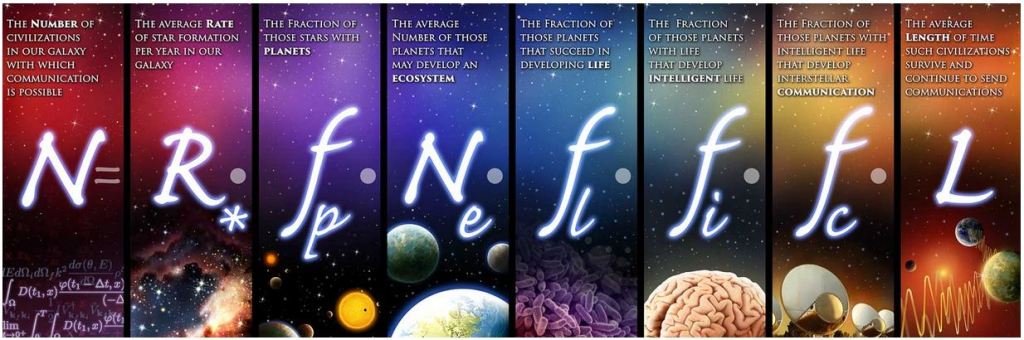
Enrico Fermi had a far simpler way of approaching the issue of alien life back in 1950 when he asked “where are they?” But the apparent absence of aliens hasn’t stopped people from looking and, more importantly, listening for signs of extra-terrestrial life. The SETI Institute (Search for Extra-Terrestrial Intelligence) was founded in 1984 and, until March 2020, included a programme whereby the public could help analyse space signals to detect deliberate radio transmissions.
Despite the public arm of SETI@home biting the dust, the latest issue (August 2020) of Physics World announced that the Breakthrough Listen initiative, which was founded in 2015 by philanthropist Yuri Milner and was subsequently supported by Stephen Hawking, has just expanded its remit to monitor 700 galactic objects that qualify as “exotica”. The theory is that we’ve tried detecting signals from distant stars and galaxies with no positive results so now we should look at other types of objects, including Oumuamua (the interstellar object that entered our Solar System in 2017)
While we wait to hear for extra-terrestrial news, you can use the online Alien Civilization Calculator, available at https://www.omnicalculator.com/physics/alien-civilization to estimate the chances of success. The default settings suggest that there could be 36 advanced alien civilizations in our own galaxy and if they are evenly spread then the maximum distance to the nearest aliens who have the technology to communicate with Earth is around 17 000 light years. That is a very long way and, more importantly, a very long time delay between transmission and reception if we were to attempt a conversation.
So let’s limit the range of distances to those that could establish a minimal conversation within a working lifetime (let’s say a 60 year delay between us sending a signal and getting the aliens’ reply). Sadly, the chances of there being alien life within this range is just 1 in 8 million!
Only time will tell whether we hear anything – assuming that the aliens (if they exist) actually want to be heard. As science fiction writer Arthur C Clarke once put it: “I’m sure the universe is full of intelligent life. It’s just been too intelligent to come here”.


A thought provoking text 🤔. If only we could speed up time….
LikeLike