Physics can get complicated at times and when it does, we use models to simplify things. The models aren’t wrong: in fact they work remarkably well, but they aren’t complete.
Electricity provides probably the best examples of this state of affairs. Models normally start at the level of “electrons as buckets carrying energy” and include the idea that electricity flows around a closed-loop circuit. The second point becomes problematic when we start to think about capacitors, which rely on a “gap” in the circuit to accumulate charge. Nevertheless, despite the circuit being “broken”, a lightbulb will still glow while the capacitor is charging or discharging.
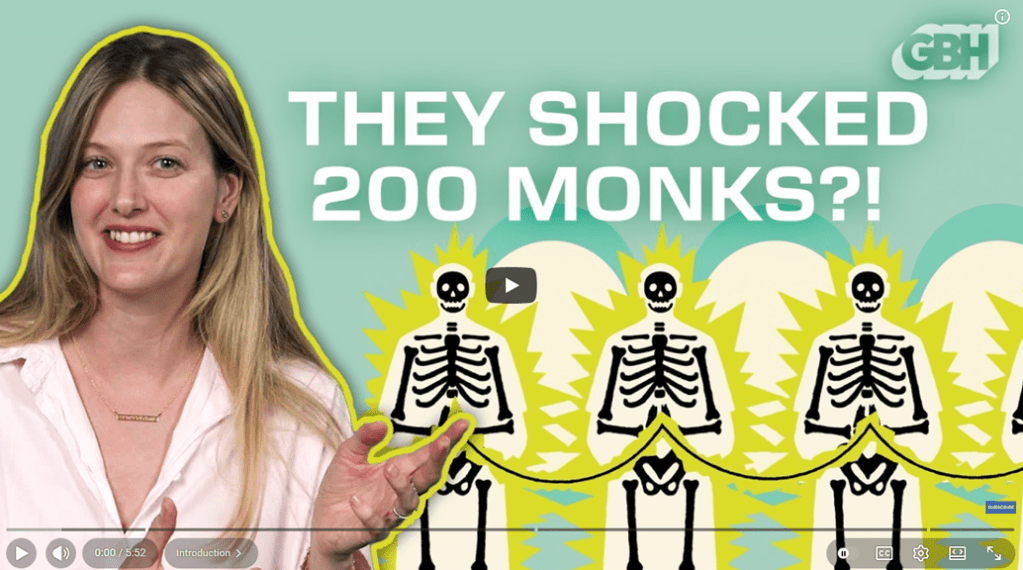
Rather than discussing the various levels of complexity in electrical models and theories, I would like to invite you to view two videos. The first is a short and very engaging What the Physics? episode from the US primetime television series NOVA, presented by Athena Brensberger.
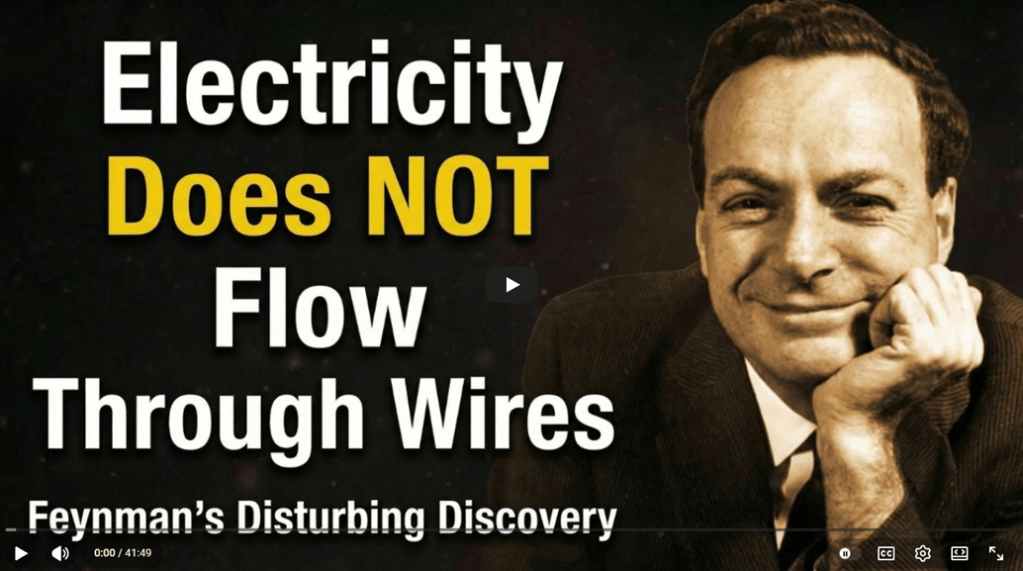
The second video is a longer and deeper explanation in the style of Richard Feynman, who shared the Nobel Prize for Physics in 1965 for the formulation of diagrams that allow the probabilities of particle interactions to be calculated. (Although we meet these diagrams in A-level physics, we don’t look at how the visual representations link to probability calculations.)
The video I have chosen below progresses from the “flow” of electricity to electromagnetic fields (Maxwell’s equations) over the course of 45 minutes. It’s a much longer watch than the first one but is well worth the time spent viewing it.
Both videos are useful and even the first one is completely sufficient for all school-based physics (including A-Level) but I am a huge fan of Feynman’s enthusiasm.
Feynman was a charismatic scientist and speaker whose lectures at California Institute of Technology were turned into a set of three books, first published in 1963 as The Feynman Lectures on Physics. These volumes have long been a definitive source for undergraduate learning.
Feynman also wrote a number of short books that offer really clear explanations of selected topics. I particularly recommend QED The Strange Theory of Light and Matter and The Character of Physical Law. The first links to Feynman’s Nobel Prize and tackles ideas such as why we can see both a reflection in a window as well as the scene that exists outside; the second looks at some of the fundamental ideas underpinning physics and the ways in which it is studied.
YouTube also hosts recordings of Feynman lecturing in-person, such his excellent 10-minute explanation of The Scientific Method (https://www.youtube.com/watch?v=EYPapE-3FRw) giving a quick taste of the second book I mentioned above. Even if you watch neither of the other two videos, watch this one!
A free-to-read online version of The Feynman Lectures on Physics is hosted by Caltech (California Institute of Technology) and can be accessed at https://www.feynmanlectures.caltech.edu/ where there are also free-to-play audio files of the lectures.

 Mr Tarrant's physbang 'blog