
Determining a spring toy’s jump height is a useful exercise in the application of physics, not only in terms of this specific example but also in highlighting contrasting approaches to answering any sort of physics question.
As is so often the case, there are two possible starting points; the first is theoretical whereas the second is empirical (based on direct measurement). At some point, the theoretical value and experimental result ought to coincide but that will only happen if the theory takes account of every contributing factor. This can be quite tricky and an experimental approach is therefore often easiest. Not only that but also it sets a benchmark for the theoretical value to match. If in doubt, measurements are normally correct and theories have to be modified to fall in line with experimental data.
In the case of the spring toy, there are two obvious theoretical approaches as well as various different methods for obtaining experimental data.
- Elastic potential energy
Given that a spring toy works by compressing then releasing a helical spring, the maximum achievable height will be given by the amount of energy that can be stored in the spring. This in turn can be determined by measuring its spring constant and the amount of compression used.
To find the spring constant, different masses are hung from the toy and each extension of the spring is measured. Alternatively, the toy could be supported inside a tube so that different compression loads can be applied and the change in length measured. Whichever method is used, a graph of force against change in length will reveal the spring constant (the gradient of the best-fit straight line through the plotted points). As always, it is better to use a graphical approach than simply to average a series of numerical values directly.
To find the compression that will be used for the launch, the spring toy is measured in its natural state and when compressed: the amount of compression is equal to the difference between these two measurements.
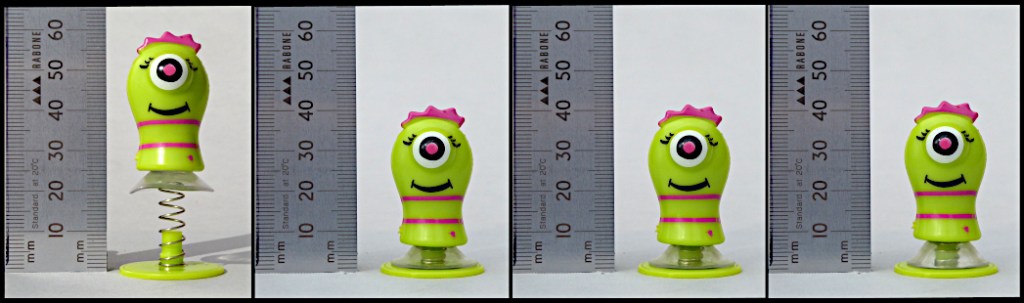
The stored elastic potential energy is given by the equation shown below;
EPE = ½ k (∆L)2
where k is the spring constant and ∆L is the change in length (natural length – compressed length).
To estimate the maximum jump height, the EPE equation is balanced against the equation for gravitational potential energy (GPE);
GPE = m g h
where m is the mass of the toy, g is the gravitational field strength and h is height above the launch position.
When these two equations are combined, the maximum jump height is predicted to be;
h = k (∆L)2 / 2 m g
The problem that arises here is the predicted height is just that, a prediction. It does not allow, for example, for the loss of spring compression before the sucker disengages from the base (as indicated in Figure 1, above). Nor does it take account of energy lost as sound, which is very obvious as a “pop” at the moment of launch. These two deficiencies lead to the second theoretical approach…
- Initial kinetic energy
Regardless of the amount of elastic potential energy stored in the spring, the most important factor is the amount of this energy that is transferred to the toy to provide kinetic energy for the jump. If we could measure the initial kinetic energy then we could predict the maximum jump height by equating and rearranging the expressions for GPE and KE, giving;
h = v2 / 2 g
It is worth noting a major advantage in favour of measuring the initial velocity: the launch takes place from a well-defined position whereas the maximum height is achieved at a point in mid-air that is hard to predict with complete certainty. The velocity can be deduced using a high-speed image sequence that records the position of the toy within the first few moments of launch, as shown below (Figure 2).

Once again, however, there are problems with this approach. Most obviously, it does not take account of work done against air resistance and therefore is likely to give an over-estimate for the toy’s jump height. Also, a single launch sequence does not give any indication about the range of heights that might be achieved and the analysis involved for multiples launch would be tedious – and still inconclusive. All of which explains why it is useful to measure the toy’s jump height directly.
- Direct measurement of jump height
As mentioned above, the biggest problem with measuring the jump height directly is that the peak will occur in mid-air, at an ill-defined position. Yes, it might be possible to put the toy into a loosely-fitting tube so that the jump is directed vertically above the launch position but any contact with the tube’s inner walls would result in a loss of energy from the toy, so reducing its maximum height.
If it were possible to launch the toy in front of a large sheet of graph paper and video the event then, in theory, it would be relatively easy to step through the recording on a frame-by-frame basis to identify the maximum height achieved. The graph paper would have to stand at least a metre high or, if it were a smaller sheet, it would need to be fixed to a wall, immediately behind the launch position, at the toy’s estimated apogee.
The problem with this method is parallax. In order to judge the height accurately using a scale that is behind the toy, it is essential that viewing takes place exactly perpendicular to the scale. If the viewing angle is slightly upwards then the height will be over-estimated and if the viewing angle is slightly downwards then it will be under-estimated. It is also important to minimise the distance between the object being measured and the scale.
Although it could be suggested that an entire bank of cameras is arranged so that one of them will record an image exactly perpendicular to the peak, there is no guarantee this will be the case as the cameras cannot be placed closer together than the physical dimensions of their lenses. A similar problem would apply to a bank of light beams, where the highest beam broken by the toy indicates the maximum height achieved. The height cannot be measured more accurately than the separation of the beams and the beams are likely to be narrow, so the toy will need to be launched truly vertically in order to give a reliable result.
A nice variation on this idea was suggested by one of my students: it involves having two metre rules that are stood vertically, exactly aligned with each other, and to launch the toy between these two “pillars”. Once the frame showing the maximum height has been identified, a line can be drawn between the two rules to measure the height reached. This is a good way to overcome the parallax problem because the pillars are in the same plane as the toy (roughly, at least) so the indicated height is likely to be a (fairly) reliable value.
Finally, there is the matter of what point on the toy to use when measuring the height; should it be the top of the toy, the bottom or somewhere in the middle? The best place to use is actually the toy’s centre of mass, which can be determined by hanging the toy by a thread from multiple points then identifying where the vertical lines for each hanging intercept.
The significance of the centre of mass is that it identifies the point at which the entire mass of the toy can be considered to be located: it is also the point about which the toy will rotate if it changes orientation during flight. The usefulness of this approach is demonstrated in high-jump techniques, where the athlete’s centre of mass is kept as low as possible so that it can skim the bar and clear the maximum height without having to accommodate “protuberances” such as flailing arms and legs.
Whoever knew that determining the height of a spring toy could reveal so much physics – and a bit of sports science too?

 Mr Tarrant's physbang 'blog