
To explore the current state of AI reliability in a physics context, two questions were put to five free AI assistants, all available via https://duck.ai/;
- Why don’t radioactive decay chains end with iron?
- Which isotope has the highest binding energy?
Before revealing the AI responses, here are my own answers.
Question 1 assumes that all nuclear decay chains should end with the most stable nucleus, which is iron-56. However, it is commonly said that nuclear decay chains end with lead so the question is really asking why that is the case when iron-56 ought to be a more stable endpoint.
It is worth clarifying that radioactive decay chains (for the spontaneous transmutations of heavy elements) don’t all finish with isotopes of lead: the neptunium decay chain ends with bismuth-209 because lead-209, which is the penultimate step, has a half-life of just 3.2 hours. And that clarification hints at the answer to the original question.
The usually-cited “final” lead isotopes aren’t necessarily fully stable but they can be considered as stable because they have near-negligible decay constants (an extremely long half-life). It would therefore be better to say the decay chains “plateau” rather than ending with lead (or bismuth). There are lower-mass isotopes that are more stable but they cannot be reached within the lifetime of the Universe, because the energy advantage for the next step is so small, and the decay chains will therefore never extend as far as iron within any practical timescale.
Question 2 lacks clarity: do the words “highest binding energy” refer to the nucleus as a whole or the energy per nucleon? The isotope with the highest binding energy per nucleon is iron-56 whereas the nickel-62 has the highest total binding energy.
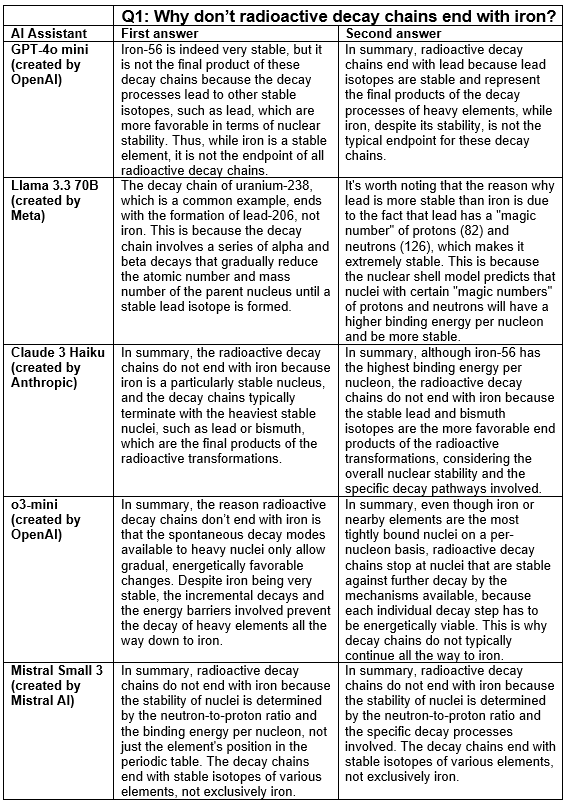
That’s how I would reply but what did the AI assistants say? The tables at the end of this post summarise the responses received. Although a certain amount of variation is to be expected, it was alarming to see that in some cases the answers varied even when the same question was put to the same AI assistant on different occasions on the same day.
The responses to Question 1, listed in Table 1, are generally good although the answers given tend to be statements rather than explanations.
But when it comes to Question 2, the AI assistants’ responses reveal two clear failings;
- It is likely that GPT4o’s reference to helium-4 having the highest binding energy per nucleon comes from a discussion of nuclei containing four nucleons. In this specific context, helium-4 does indeed have the highest binding energy but only when heavier elements aren’t considered!
- Llama 3.3 and o3-mini both failed to distinguish correctly between the isotope that has the highest total binding energy (nickel-62) and the isotope that has the highest binding energy per nucleon (iron-56).
In summary (to use AI-assistant terminology) it is likely that AI-generated answers will be correct to some extent but they may not be correct in detail or in the specific context that the questioner had in mind. Responses are also more likely to be statements than explanations.
My own recommendations for better answers, based on searches conducted using duckduckgo.com then choosing links considered to offer the highest quality sources, are as follows;
Question 1: The best answer is a combination of two sources: the first is Nicolau Saker Neto’s reply to a similar (but oppositely-phrased) question on chemistry.stackexchange, which can be read at https://chemistry.stackexchange.com/questions/42922/why-do-all-radioactive-decay-series-terminate-at-lead; the second part comes from AXensen, who identifies as a PhD student in the physics program at University of California, Berkeley, working for the ALPHA experiment at CERN studying antihydrogen. AXensen’s answer, in response to a question on physics.stackexchange about whether all elements heavier than iron will eventually decay to iron, is available at https://physics.stackexchange.com/questions/803817/is-there-proof-for-elements-heavier-than-iron-will-decay-to-iron-by-processes.
Question 2: Both variants of this question (the highest binding energy for the entire nucleus and the highest binding energy per nucleon) are covered in an outstanding explanation by Dr Christopher Baird of West Texas University, USA. It’s a long post but it really is worth reading in full at https://www.wtamu.edu/~cbaird/sq/2024/07/23/what-is-the-most-stable-nucleus/.
The full responses from the five AI assistants can be downloaded here and I have also extracted from the recommended sources some key facts that can be downloaded here.


 Mr Tarrant's physbang 'blog