As the nights draw in and skies get darker we approach the time of year when aurorae become easier to observe, especially at times (like now) of high sunspot activity. But the link between aurorae and events happening on the surface of the Sun is not immediately obvious and was initially deduced only indirectly.
Subject to favourable conditions, aurorae must have been witnessed with awe for thousands of years, long before anybody attempted to explain the strange dancing patterns of coloured light seen in the sky at certain latitudes.
Aurorae were documented more than 2500 years ago in a dated Late Babylonian astronomical text that records a “red glow” seen in the sky during the night of 12/13 March in 567 BC (https://academic.oup.com/astrogeo/article/45/6/6.15/216214) but they were also included in prehistoric cave paintings that date back more than 30,000 years (according to the website of Apukka Resort, which offers Northern Lights experiences in glass igloos, https://apukkaresort.fi/blog/good-to-know/northern-lights-facts/).
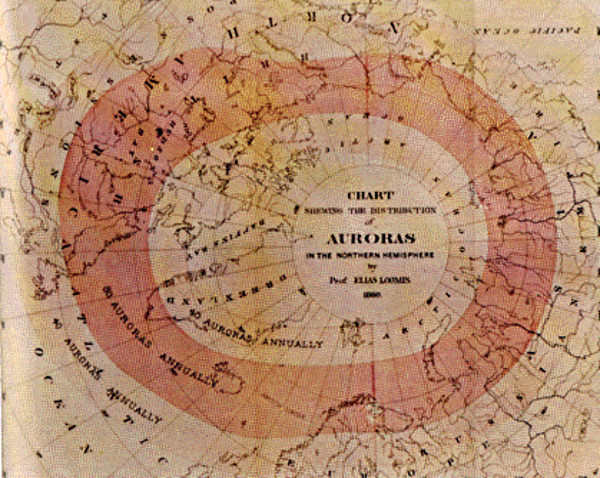
The first methodical survey of aurorae was conducted by Elias Loomis, who published a map in 1860 showing that aurorae (in the Northern hemisphere) get more common closer to the North pole but then decline again. The zone of maximum occurrence, offering at least 80 sightings in an average year, was revealed to be an oval that is centred near the north-west end of Greenland.
In a parallel development, the Earth’s magnetic field turns out not to be as simple as was first deduced in ancient China, when magnetic needles were floated on water using pieces of cork. The fact that compass needles point North was revealed to be an over-simplification by George Graham who, using his skills as a watchmaker, built an ultra-sensitive compass and made daily recordings of its direction between 1722 and 1723. His results showed small but definite variations in the position of “North”.
A few years earlier, Edmund Halley (of comet fame) had noticed that aurorae visible over London in 1716 appeared to have rays converging towards the Earth along magnetic field lines. And so it was that George Graham teamed up with a group of Swedish scientists, including Anders Celsius (of temperature fame) to investigate whether there was a genuine link between aurorae and the Earth’s magnetic field. Graham and Celsius found that on days when there were compass fluctuations in London there were also aurorae in Uppsala, Sweden.
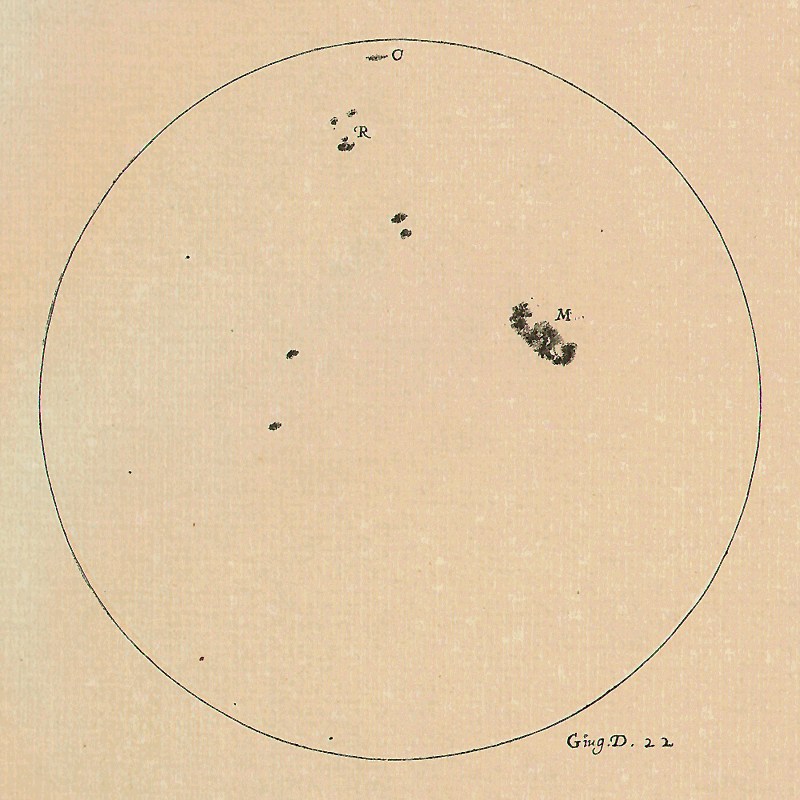
But none of this links aurorae to activity on the Sun: to make that connection we have to step back to the work of Galileo Galilei, who sketched “spots” on the surface of the Sun between 1612 and 1613 using an early telescope. At that time there was uncertainty about whether the spots were truly on the surface or whether they were objects passing in front of the Sun.
Returning to the mid-Eighteenth Century, we find the Sun is being observed on a regular basis and in 1844, after making drawings of sunspots for 17 years, German amateur astronomer Heinrich Samuel Schwabe suggested there might be an approximately 10-year cycle in the Sun’s activity as indicated by the number of sunspots observed. Ironically, and echoing the earlier alternative explanation given for Gallileo’s sunspots, Schwabe had actually been trying to find evidence for a planet closer to the Sun than Mercury.
Nevertheless, Schwabe’s findings caught the eye of German astronomer Rudolf Wolf, who used data recorded by the Zurich Observatory, going back to 1749, to identify what we now regard as an 11-year cycle of sunspot activity.
Within a few years, Professor Wolf and Dublin-born geophysicist and astronomer Edward Sabine, who was in charge of a worldwide network of British observatories tracking geomagnetic changes (for their potential effect on compass-based navigation) had independently linked geomagnetic activity to sunspot activity. Sabine’s global data collection was described by contemporary historian William Whewell as “by far the greatest scientific undertaking the world has ever seen”.
So by the middle of the Nineteenth Century there was a known link between aurorae and magnetic fluctuations, as well as a separate link between magnetic fluctuations and sunspot number. Could it be that aurorae are therefore linked to sunspot number – not simply by coincidence but because there is a causal connection?
The answer is yes – but how?
That’s something I’ll cover next time.
This is the first in what will be a brief series of posts prompted not only by the change of season but also my recent reading of Mark Moldwin’s book Introduction to Space Weather (2nd edition) published by Cambridge University Press, 2023. ISBN: 978-1-108-79171-7.

 Mr Tarrant's physbang 'blog
