Chandra is the unsung hero of space telescopes. Far better known is the Hubble Space Telescope, which is rightly famous for the spectacular images it has produced. But Hubble was only ever intended to be one arm of a four-pronged approach to astronomical observations, another of which is provided by Chandra.
Whereas Hubble produces images using visible or near-visible light, its three companion space telescopes were designed to detect other parts of the electromagnetic spectrum. The Compton Gamma Ray Observatory and the Spitzer Infrared Space Telescope have been retired but the Chandra X-Ray Observatory is still going strong. This is a really important fact because whereas Hubble is now supported by the James Webb Space Telescope, the x-ray spectrum remains unique to Chandra.
To celebrate 25 years of Chandra’s x-ray observations, NASA has released a series of animations showing the evolution of two supernova events over a period of two decades.
The first depicts the Crab Nebula, which is the remnant of a supernova explosion recorded by Chinese astronomers in the year 1054. At its centre there remains a pulsar (rotating neutron star) that spins on its axis about 30 times a second, sending out radiation that scans across space like a lighthouse beam.
Chandra’s observations of the Crab Nebula have been compiled into a time-lapse animation that reveals how the “explosion” has progressed from February 2000 until March 2022. The images show not only expanding “shells” of debris but also “whipping” of the x-ray jet that is believed to contain both matter and anti-matter particles.
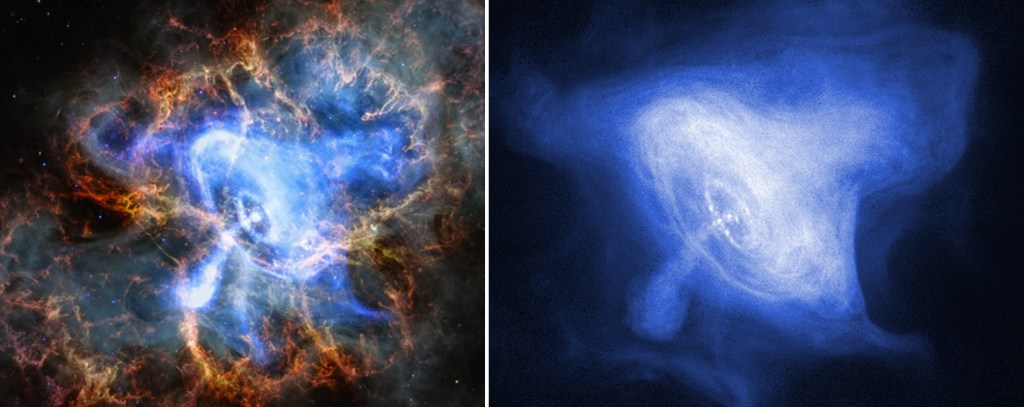
A brief (21s) animation containing both of the two views shown above is available at https://chandra.si.edu/photo/2024/timelapse/timelapse_crab_comp_to_blue.mp4
The second animation celebrating Chandra’s achievements depicts the remains of the Cassiopeia-A supernova, which occurred about 340 years ago, and was created using images captured between 2000 and 2019,
In this case, the sequence of pictures reveals an expansion that hesitates as a shock wave “rebounds” back towards the centre of the supernova. Once again, the central remnant is a neutron star that is an intense source of x-rays. The Cassiopeia-A animation, again combining Chandra’s x-ray data with the JWST’s infrared data, is available to view at https://chandra.si.edu/photo/2024/timelapse/timelapse_casa_comp_to_blue.mp4
It is worth noting that although these 20-year composites represent an impressive lifespan for a space telescope, they are but the briefest of periods in astronomical history.
More information about both animations is available on the Chandra website at https://chandra.si.edu/photo/2024/timelapse/ and https://chandra.harvard.edu/photo/2024/timelapse/animations.html

 Mr Tarrant's physbang 'blog