It would be fair to say that whereas astronomy is an observational science, cosmology uses those observations to model the Universe. With this distinction in mind, there are a number of forthcoming events and publications that I think are worth highlighting.
First and foremost is next week’s (April 8th) total solar eclipse, which will be visible along a path running up the United States. Multiple timetables for the event have been published, including one from astronomy.com (https://www.astronomy.com/observing/how-to-see-the-2024-eclipse-times-livestream-and-a-state-by-state-guide/ ) and another on the space.com website (https://www.space.com/what-time-total-solar-eclipse-april-8). The latter also has a page that will be streaming live coverage from NASA TV and others for the benefit of those who don’t live under the shadow’s path (https://www.space.com/watch-total-solar-eclipse-april-8-online-free-livestreams).
UPDATE: The picture shown below, posted on Facebook by the International Space Station team, shows the eclipse seen from the ISS, orbiting some 400 km above the Earth’s surface.
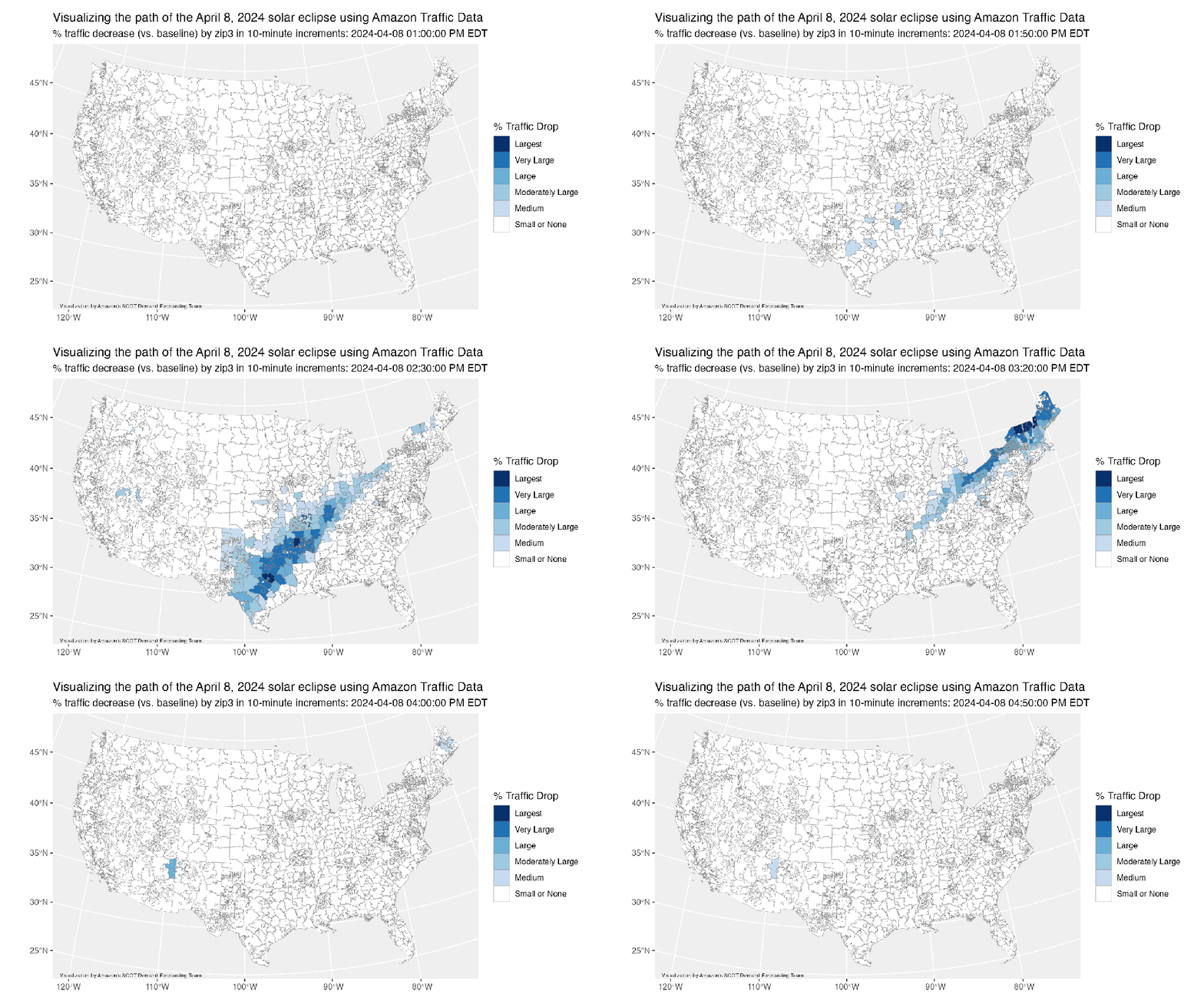
Below that is an animated graphic (a data visualisation created by Amazon’s Supply Chain Optimization Technologies team) showing how web traffic to Amazon’s websites dropped as the solar eclipse passed overhead. It seems that if the attraction is strong enough, people really can be persuaded to put down their technology devices and enjoy the world IRL!

A particularly interesting piece of work prior to the eclipse has been modelling its likely appearance before the eclipse happens. This is important because our ability to model and predict physical phenomena successfully is what validates our theoretical knowledge. The latest animation is available to view on the Predictive Science website at https://www.predsci.com/corona/apr2024eclipse/home.php
An even bigger event, in the sense of both its own scale and the fact that it will be visible across the Northern hemisphere, is the anticipated nova explosion of T-CrB that is expected to occur some time over the coming months (before September) in the constellation of Corona Borealis.

There is a nice summary of the T-CrB event, with a close-up star map, at https://www.bbc.com/future/article/20240322-visible-nova-explosion-is-coming and NASA has published an animated artist’s impression of the event at https://blogs.nasa.gov/Watch_the_Skies/2024/02/27/view-nova-explosion-new-star-in-northern-crown/
Finally, there is a new article by Don Lincoln, published in the April 2024 edition of The Physics Teacher, explaining the history and current understanding of Cosmic Inflation in a very accessible way. The full article is available at https://pubs.aip.org/aapt/pte/article/62/4/250/3279708/What-Is-Cosmic-Inflation and can be downloaded as a pdf for off-line reading if so desired. Lincoln, who is a particle physics researcher at the Fermi National Accelerator Laboratory in Illinois, is a brilliant science communicator and also presents the Fermilab programs on YouTube, all of which are listed at https://www.youtube.com/playlist?list=PLCfRa7MXBEsoJuAM8s6D8oKDPyBepBosS

 Mr Tarrant's physbang 'blog