
We can define a wave as something that carries energy from one place to another without the transfer of physical matter.
To understand this definition it is useful to think about two different ways of feeling heat. In a shower, heat is created by an energy exchange inside the storage tank or shower unit and is transported to you in the form of hot water. The water carries the heat and there is a transfer of physical matter so we can be sure that the heat is not being carried by a wave. But if you go outside on a summer’s day you will be able to feel warmth on your skin. In this case, there is no matter moving from the surface of the Sun to your skin and you are feeling heat energy that has been carried by waves travelling through empty space.
Waves are vibrations (or oscillations) that can occur in either of two directions. If the direction of the vibration is the same as the direction of wave travel, we say the wave is longitudinal. You can remember this by recognising that longitudinal suggests the vibrations go along the wave. Sound is the most common form of longitudinal wave and if you were to experience a very loud sudden sound, such as an explosion, then the shock wave (sound) could knock you over as its vibrations bash into you. Even loud music can cause small objects to rattle if they are placed directly on top of a loudspeaker.
The other direction of vibration is at a right-angle (perpendicular) to the direction of wave travel and is commonly seen when a rope is shaken to produce a wave pattern. The rope moves up and down but the wave moves forward. We call this a transverse wave: visible light and infrared (heat) waves are common examples of transverse waves. (“Trans” means “across” so in this case the movement of the vibrations is across the movement of the wave itself.)
Acoustics expert Dan Russell has created some great animations showing the movement of particles in the two different types of waves. The animations are on Pennsylvania State University’s website and can be viewed by clicking here. (The animations also include water and surface waves, which are not covered in GCSE courses.)
Even though their vibrations are different, both types of waves are represented using the same sort of diagram and two features are particularly important as they define the properties of the wave – as marked on the diagram below.
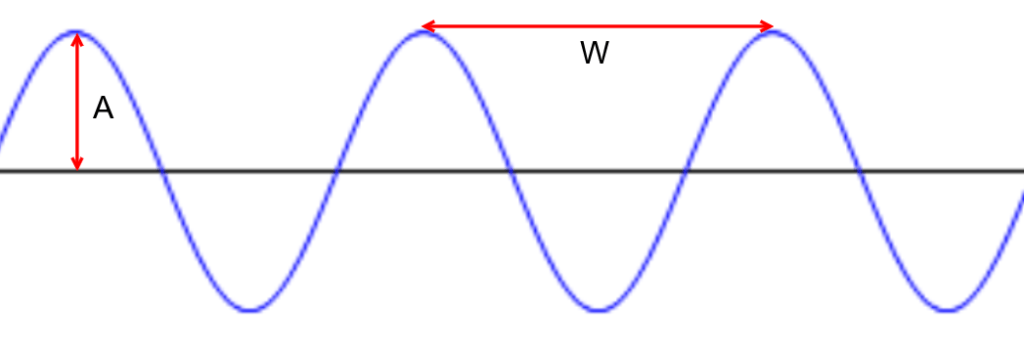
The height of the wave, measured by a vertical line from the middle of the wave to the top of a peak (A), is the amplitude. The distance between identical parts of the wave, such as from one peak to the next one (W), is known as the wavelength.
Increasing the amplitude gives more volume for a sound wave or more brightness for a light wave. Reducing the wavelength, by forcing the peaks closer together, creates a sound with a higher note or light with a bluer colour.
It is common to talk about the frequency of a wave, which is inversely proportional to its wavelength. So a longer wavelength corresponds with a smaller frequency. In fact, if you multiply the wavelength and the frequency together for the same types of waves, you always get the same number. It happens that this constant number is the wave velocity, which is the speed at which the wave moves forward (not the speed of the vibrations).

Wave velocity (speed) is in m/s when the wavelength is measured in metres and the frequency is in hertz (Hz).
The speed of sound in air is roughly 300 m/s. Sound travels faster in solids than it does in gases but even gases vary and the reason why people have a high-pitched voice when talking after breathing helium is that the speed of sound in helium is faster than it is in air.
The speed of light is 300 000 000 m/s, which is about a million times faster than the speed of sound in air. This explains why you see a lightning flash before you hear its clap of thunder: they were both created at the same moment but the light reaches your eyes much faster than the sound. More importantly, light can travel through empty space whereas sound requires a medium, such as the air.

 Mr Tarrant's physbang 'blog
One thought on “Key Facts: Waves”