
Every GCSE physics paper normally has at least one question with a mark for the correct interpretation or expression of numbers in standard form. This is a basic skill that is taught as part of GCSE mathematics courses but it holds a great deal of power for scientific calculations that is rarely mentioned at this level.
Standard form involves splitting numbers into two parts; a value and a power of ten. Two examples are shown below.

The rules for standard form are as follows;
- the value must be greater than or equal to one and less than 10
- the value can be either positive or negative
- the power of ten must be an integer
- a positive power of ten magnifies the value by moving the decimal point to the right (and adding zeroes)
- a negative power of ten makes the value smaller by moving the decimal point to the left (and adding zeroes)
Using these rules, the two examples given above can be put into decimal form, as 4490 and 0.00701 respectively. If you aren’t sure about how those conversions were done, there are various resources that explain the techniques: for a good written explantion try mathsisfun and if you prefer video explanations then visit khanacademy.
Standard form comes into its own when multiplying or dividing large numbers. For example, let’s say that you want to know how many moons would be needed to equal the mass of the Earth. The masses of the two objects, taken from NASA’s factsheets, are;
- mass of the Earth = 5.972 x 1024 kg
- mass of the moon = 7.346 x 10²² kg
The required calculation involves dividing the mass of the Earth by the mass of the moon, which could be done by entering the full numbers into a calculator (often using a button marked EXP to get the ten-to-the-power function). But there is a simpler way…
When dividing two numbers in standard form, only the values need to be divided: the powers are simply subtracted. In the case of our Earth-and-moons calculation, that looks like this;
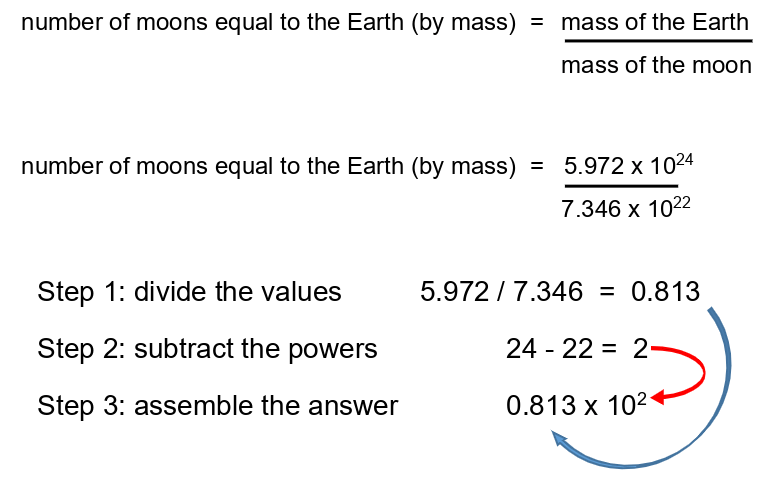
This isn’t quite the final answer because the value does not meet the range requirement for proper standard form. To correct this, we multiply the value by 10 and drop the power by one, giving 8.13 x 101.
This is a fairly obvious example that converts to 81.3 moon masses but many physics calculations don’t produce such easy answers and are made much simpler by working in standard form.
A common type of GCSE physics question involves working out the wavelength of a certain frequency of light (or other electromagnetic radiation) and this is a situation where standard form may well be assessed as part of the mark scheme. For example;
Q: Calculate the wavelength of yellow light that has a frequency of 5.45 x10¹⁴ Hz. Write your answer in standard form. In your calculation, the value to use for the speed of light is 3.00 x 10⁸ m/s.
A: The required calculation involves dividing the speed of light by the frequency given. This can be done using the standard form method, as follows;
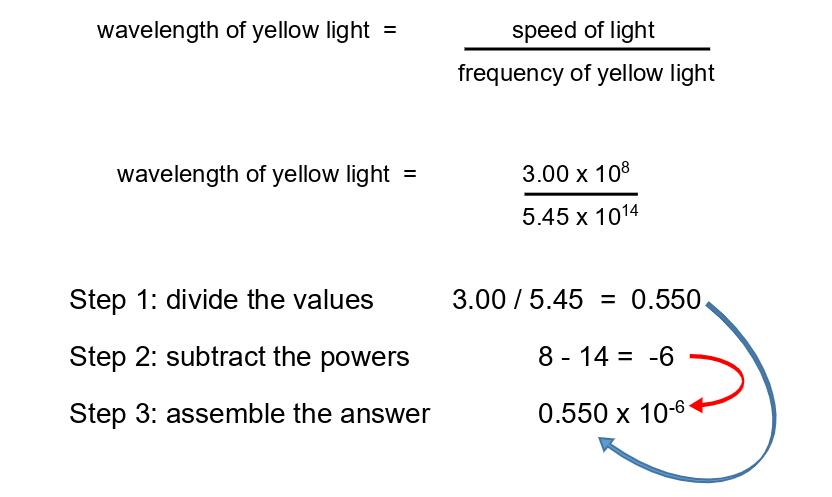
As was the case in the first example, this answer isn’t in proper standard form as the value is not within the required range. The final step is therefore to multiply the value by 10 and reduce the power by one, giving a final answer of 5.50 x 10⁻⁷ m. Note that reducing the power by one involves using a larger number because, in this case, the power is negative.
The method for using standard form in multiplication calculations is slightly different but just as easy…
When multplying two numbers in standard form, the values are multiplied and the powers are added.
To see how this works in practice, we can use the equation to calculate photon energy, which is included in some GCSE physics courses and is required knowledge at A-level. The necessary equation is;
E = h x f
where E is energy (in joules, J), f is frequency (in hertz, Hz) and h is a fundamental constant known as Planck’s constant, which has a value of 6.63 x 10⁻³⁴ Js-1.
So to find the energy of a photon of yellow light with a frequency of 5.45 x 10¹⁴ Hz, the method is as follows;
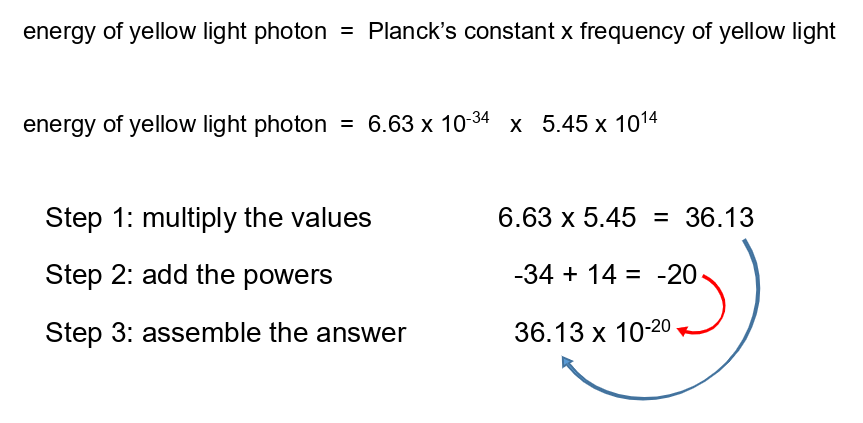
Once again, the calculated answer is not in proper standard form (as the value is greater than 10). The final step in this case is therefore to divide the value by 10 and increase the power by one, giving a final answer of 3.613 x 10⁻¹⁹ J.
You may spot that a major advantage of the standard form method is it allows answers to be estimated very quickly by adding or subtracting the powers, as appropriate. Since the powers normally dominate the final result, it is very easy to get a good idea about the expected magnitude of the answer almost instantly!

 Mr Tarrant's physbang 'blog