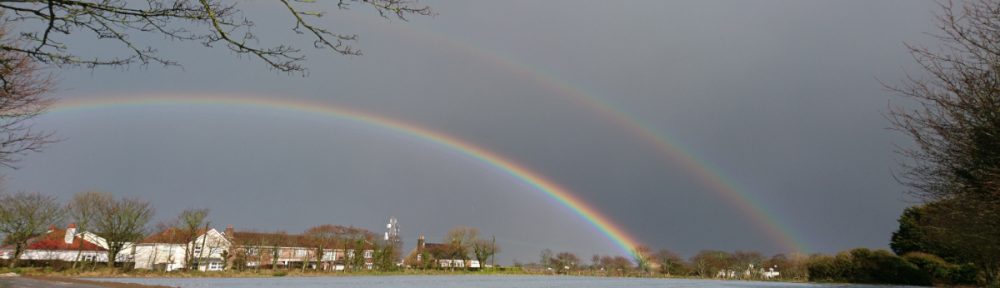
Optical illusions aren’t part of the school science curriculum – but they should be. We tend to believe what we see, and a lot of what we know about science is based on visual observations, but we aren’t normally taught to question the evidence of our own eyes.
One of the classic puzzles of astronomy, known as Olber’s Paradox, predicts that if the Universe is infinite, homogenous and isotropic (basically, the same everywhere) then the night sky should be bright because every line of sight would end at a star. Clearly, the night sky isn’t bright so maybe our underlying assumptions are wrong – or maybe we shouldn’t rely so much on naked-eye evidence.
The image below shows an area of the night sky known as Barnard-68, which is an example of a region of visual blackness known as a Bok globule. On the left, the region has been photographed using mostly visible light with a contribution from the near-infrared part of the electromagnetic spectrum. The central region is dark because stars have not yet formed there. We might be tempted to ask what is causing the delay in star formation but, as the right-hand image shows, the blackness itself is merely an illusion.

The picture on the right was taken using a telescope with extended infrared sensitivity and reveals the area of ‘nothingness’ to be far from black. Although the dust cloud in Barnard-68 absorbs visible light, rendering distant stars invisible, longer wavelengths from the middle of the infrared region are not absorbed and the ‘hidden’ stars are revealed. The dust will eventually collapse to form new stars but for now it would obstruct our view of what lies beyond were it not for the penetrating power of infrared telescopes.
It is impossible to overstate the importance of infrared observations for modern astronomy and if you are ever asked to suggest a use for the infrared part of the electromagnetic spectrum then this is one of the best examples. By all means remember that television remote controls use infrared signals, as do thermal cameras that provide night vision, but don’t forget astronomy. The James Webb Space Telescope, which was launched at the end of 2021 and is now vastly expanding our knowledge of the early Universe, works entirely in the infrared region and it is this fact, together with its large mirror, that makes it so potent.

 Mr Tarrant's physbang 'blog