The shape of the magnetic field around a bar magnet should be familiar to you as it has been covered in detail in a previous article, which you can read here. But rather than just knowing this shape, it is important that you can describe how to investigate it. There are two versions of this experiment: you may have done them yourself or you may have seen them being demonstrated.
The first method involves placing a bar magnet under a sheet of white paper and gently sprinkling iron filing onto the top surface of the paper. As the iron filings fall through the air, they feel a force due to the bar magnet’s magnetic field and this causes them to accumulate where the field is strongest. In addition, the iron filings become induced magnets (read this article if you’re not sure what “induced magnets” means) and that causes them to link together along lines of equal magnetic field strength.
The result is a pattern similar to the one shown below.

I have mentioned before, but it’s worth repeating here, that magnetic fields are three-dimensional structures even though we draw them as 2-D patterns on paper. The fact that the iron filings are pulled into different areas as they fall through the air proves that the bar magnet’s magnetic field extends above the plane of the paper. There is a nice 3-D animation showing this, which you can view here. The view can seem confusing at first because the field lines are “dotted” so that you can see through them. Take a moment to work out what you are seeing as I promise that it will be worth the effort!
The second way to investigate the shape of magnetic fields involves using a small compass, known as a plotting compass. The big advantage of a compass is that it points in a specific direction whereas iron filings lack any label to indicate the direction in which they are aligned.
To use a plotting compass, place the compass at a location near to one end of the magnet and put a dot at the edge of the compass where the needle is pointing. Then move the compass so that the back end of the needle is aligned with the previous dot and make a new dot where the needle is now pointing. Continue this process until you reach the opposite end of the magnet. Then join the dots in a smooth curve and add an arrow showing the direction in which the needle pointed as it was moved along the arc that you have drawn. When you have finished the first line, choose a different starting position and repeat the entire process to draw another field line. And so on until you have drawn a set of lines on each side of the magnet, as indicated below.

Note that multiple plotting compasses are shown in the diagram above to illustrate some of the different (subsequent) positions used. When doing the practical, you must use just one plotting compass and move it to multiple positions: if you try to use multiple compasses simultaneously, the compasses will align themselves due to their own magnetic fields instead of following the field lines of the bar magnet.
To evaluate the two methods, remember that using iron filings is easier and suits different shapes of magnets, including a horseshoe magnet, as shown below. But iron filings don’t reveal the direction of the magnetic field. The plotting compass method reveals direction but requires enough space to be able to move the compass around, so it’s not really viable as a method for investigating horseshoe magnets, where the poles are very close together.
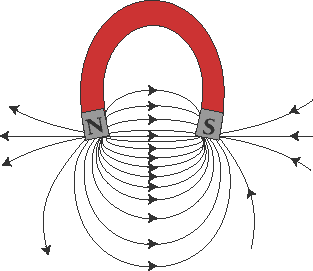
As you might guess, in real-world situations we use neither iron filings nor plotting compasses! Instead, electronic measurement instruments are employed to determine the direction and strength of magnetic fields.
If the Earth didn’t have its own magnetic field, it is likely that magnetism would have been discovered much later than it actually was – simply because nobody would have dug any lodestone out of the ground (as explained previously). It was the Earth’s magnetic field that created the lodestone’s magnetism as the rock cooled, and that in turn tells us that something deep inside the Earth is behaving as a giant magnet.
By convention, we describe a compass as having a north-seeking needle as the compass points to the Earth’s north pole but, in order to attract the north-seeking pole, the Earth’s magnet must have a magnetic south pole at the Earth’s north pole (remember that opposite magnetic poles attract each other).
As well as being used for navigation, the Earth’s magnetic field also protects the Earth from solar radiation (which causes the Northern Lights). This is beyond the GCSE course but it’s interesting stuff. You can read more about the importance of the Earth’s magnetosphere, and how it has changed through time, on NASA’s climate website, here.

 Mr Tarrant's physbang 'blog