
The principle of resultants states that when two or more forces act on an object, they can be replaced with a single force that has the same effect as the multiple forces combined. This is a fairly simple idea but putting it into practice can produce a lot of confusion so let’s start with a simple scenario.
We will begin with a cyclist, where there are two forces acting in exactly opposite directions: the forward force is provided by the cyclist and the backward force comes from friction (including air resistance).
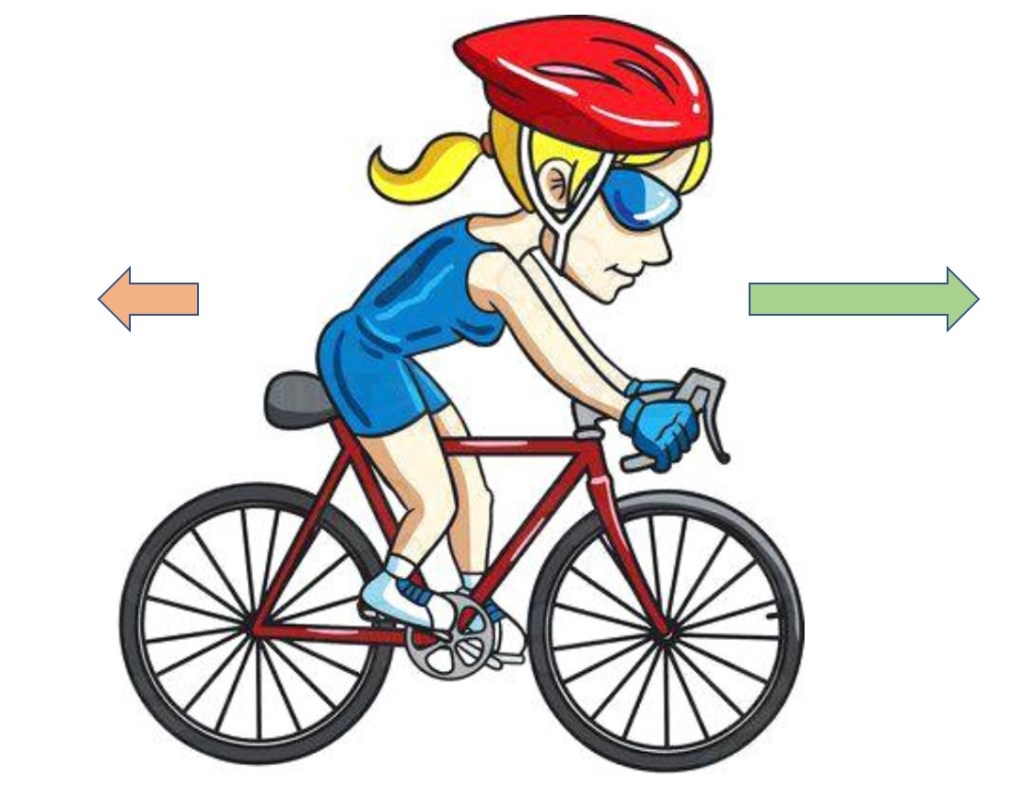
When you first met forces, you may have been told to subtract forces that act in opposite directions in order to find the overall effect – but this is unhelpful when we get to GCSE. In fact, forces are always added but forces are vectors so we also need to allow for the direction of each force. In the cyclist example above, the forwards force is in the +x direction (of a graph’s axes) so is said to be positive whereas the backwards force is in the -x direction (of a graph’s axes) and is said to be negative.
Summing the forces in this situation therefore involves adding a positive number (the forwards force) to a negative number (the backwards force). This is mathematically equivalent to subtracting the magnitudes of the two forces, so the instruction to subtract is valid but the process is logically wrong: it is the sum of the two vectors, taking their direction into account, that determines their overall effect.
Another commonly-used situation with opposite forces is the case of a skydiver, who falls quickly at first but experiences air resistance that gets stronger as the velocity increases. The downwards force (the weight of the skydiver) should be negative as it is in the -y direction; the upwards force (air resistance) should be positive as it is in the +y direction. Sometimes the weight is made positive and the air resistance is negative but, either way, we can simply subtract the magnitudes of the two forces because we are dealing with a positive force and a negative force that act in exactly opposite directions.
Although the act of summing two vectors goes much deeper than simply subtracting their magnitudes, subtraction works for situations where the forces are colinear and in exactly opposite directions.
Importantly, the best way for us to find the sum of two vectors (in GCSE Physics problems) is to use a scale drawing.
Our scale drawing must have line lengths that are proportional to the magnitude of the vectors. In addition, the directions of the lines (shown using arrows) must match the direction of each force. The two vectors are joined nose-to-tail and the remaining “gap” reveals the magnitude and direction of the resultant vector. Here’s that method put into practice for the cyclist…
On the left of the illustration below, the two force arrows have been joined nose-to-tail. The green arrow is the forward force from the cyclist’s effort and takes you to the right in the diagram; the orange arrow is the frictional force and returns you a shorter distance to the left.

On the right of the illustration, a blue arrow has been added going directly from where the green arrow starts to where the orange arrow finishes: the blue arrow therefore gives the same effect as the green and orange arrows combined. The blue arrow is the resultant.
If the green arrow represents a force of +500 N (drawn as an arrow that is 5 cm to the right) and the orange arrow represents a force of –300 N (drawn as an arrow that is 3 cm to the left) then it is clear that the blue arrow, the resultant, must be a force of +200 N (corresponding with an arrow that is 2 cm to the right).
Given that forces are vectors, we should never describe the resultant by magnitude alone (200 N). To complete the answer, we must add the fact that the resultant acts to the right, or forwards in terms of the cyclist (as indicated by the ‘plus’ sign).
Summary: In this short explanation we have converted the simple idea of subtracting forces (that act exactly opposite to each other) into a more useful general principle that involves finding the sum of vectors using scale drawings. This is a very powerful tool that we will explore in greater detail in the next article.

 Mr Tarrant's physbang 'blog
One thought on “Resultant Forces (part 1)”