As was announced back in August 2020, the second reactor at Hunterston B nuclear power station is being “switched off” today (7th January 2022). Interestingly, one UK newspaper reported this as an “early” closure as the plant’s owner, EDF, had originally hoped to keep it running until 2023, but this has to be put into context. Hunterston B first went live in 1976 and had an initial service life of 25 years but has in fact been generating electricity in Scotland for more than 40 years.
The move to decommissioning has been prompted by ongoing issues with cracks, which were first spotted in 2014, in the reactor’s graphite core. (Hunterston is an Advanced Gas-Cooled Reactor that has a completely different design from that used for modern Pressurised Water Reactors.) The graphite acts as a moderator, slowing down neutrons so they can be captured by uranium nuclei to sustain nuclear fission at a controlled rate.
It was always expected that the structure of the graphite core would change over time due to irradiation, and the extent to which this occurs in practice is an important factor that limits an AGR’s expected lifetime. There is lots of information about the role of graphite in AGRs on the EDF website at https://www.edfenergy.com/about/nuclear/graphite-core.
The closure is important as nuclear power provides zero-carbon electricity and for every nuclear station that closes, additional capacity is needed from renewables if increasing carbon emissions from fossil fuels are to be avoided. This will be compounded later in this year as EDF is also scheduled to close another AGR, Hinkley B, in July.
With all of this in mind, it is worth noting that during 2021 fossil fuels provided the greatest proportion of generated electricity. The overall breakdown of energy sources used for electricity generation, according to https://grid.iamkate.com/, was as follows;
- 42% from fossil fuels
- 24% from renewables
- 16% from nuclear
- 9% from other sources
Yes, this doesn’t total 100%: that’s partly due to rounding but mostly due to imported electricity.
In your course, you are expected to be able to describe and interpret data about energy sources used for electricity generation. UK exam boards seem particularly keen to stress the increasing contributions from renewable resources as part of the decarbonisation of electricity but I would also like you to recognise the valuable role that has been played by nuclear power.
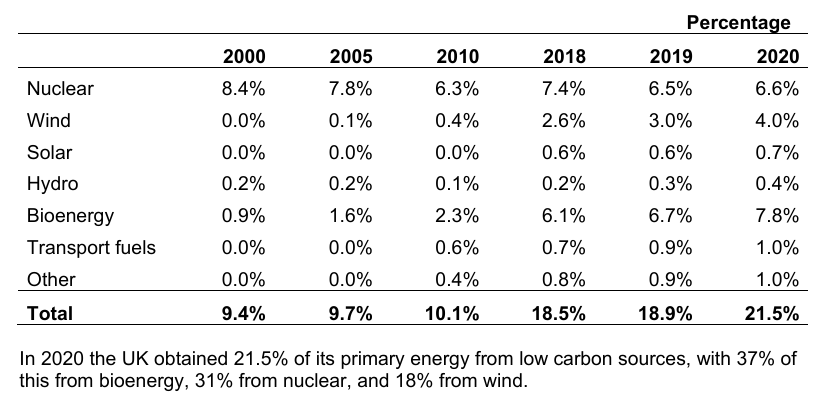
To practise your analytical skills, you may wish to look at the table above and read the summary sentence that follows the table. Can you explain why the summary sentence uses percentages that are different from those listed in the table?
For those with a deeper interest in this topic, I recommend reading the UK government’s own summary, from which the table above has been taken. The full report is available at https://assets.publishing.service.gov.uk/government/uploads/system/uploads/attachment_data/file/1032260/UK_Energy_in_Brief_2021.pdf.

 Mr Tarrant's physbang 'blog
One thought on “Farewell to Hunterston B”