
Often it is true in physics that if you can understand one thing then it will automatically help you to understand something else. A good example of this occurs in resistance, where the model of resistance in a wire links directly to the behaviour of circuits that have resistors arranged either in series or in parallel.
Let’s start with our familiar model of electrons travelling down a wire, as shown in the animation below.
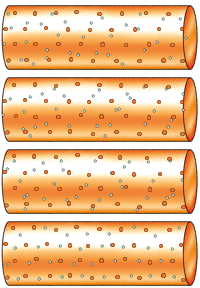
The red circles in the animation are metal ions, which vibrate but they don’t move. The green dots are electrons that are moving along the wire through the gaps between the metal ions. Effectively, the metal ions are obstacles that the electrons must pass around in order to carry their electricity along the wire. (In real life, the ions should be much larger than the electrons but that doesn’t affect the basic idea behind the model.)
The longer the wire, the more obstacles the electrons must travel around and therefore the more energy they will transfer to the wire as they go down the length of the wire.
This tells us that the resistance of a wire will increase when its length increases.
In fact, we can predict that doubling the length of the wire will double the resistance. In other words, putting an extra length of wire after the first length of wire means we must add the resistances together. That’s exactly the same as what happens in a series circuit, where we have to add together the values of the resistors that come one after the other to get the total resistance.
This model also explains why the current is the same everywhere in a series circuit – because the same electrons are passing on their energy along the same route all the way around the circuit. There is nowhere else for the electrons to go so there has to be the same rate of electron movement (current) everywhere, otherwise the electrons would “pile-up” or “run out” in certain parts of the circuit.
Now let’s think about having a thicker wire. The greater the diameter of the wire, the more paths there will be for the electrons to use when trying to go around the obstacles. This means the electrons are able to find an easier path and they therefore transfer less energy to the wire.
This tells us that the resistance of a wire will decrease when the thickness of the wire increases.
This same model even allows us to understand why a hotter wire (such as a brightly-glowing filament in a light-bulb) has more resistance. This is because the metal ions vibrate more when their temperature increases (because they have more energy) and these vibrations make the gaps between the ions smaller. This narrows the paths that the electrons are using to get past the obstacles and therefore the electrons transfer more energy to the wire.
In other words, as the temperature of the wire increases, the resistance of the wire also increases.
The next thing you should do is remind yourself about series and parallel circuits (in this post) then try building some circuits using an online simulation (see this post) so that you can take some virtual measurements and calculate resistances in different situations using the usual equation;
resistance (ohms) = potential difference (volts) / current (amps)
Remember that in symbol form, the capital letter I stands for current, so the symbol equation is;


 Mr Tarrant's physbang 'blog
One thought on “Resistance theory”