
There is a great cross-over between two topics, waves and electricity, when we come to moving-coil microphones and loudspeakers. This pair of devices can be thought of as the sound-wave equivalent of motors and generators. Motors turn electrical energy into kinetic energy whereas generators turn kinetic energy into electrical energy. Similarly, microphones turn sound waves into electrical signals whereas loudspeakers turn electrical signals into sound waves.
There are various different designs for microphones and loudspeakers but we are interested only in the moving-coil type. In this design, a lightweight coil is suspended between the poles of a cylindrical magnet and attached to a large cone (for loudspeakers) or a small diaphragm (for microphones).
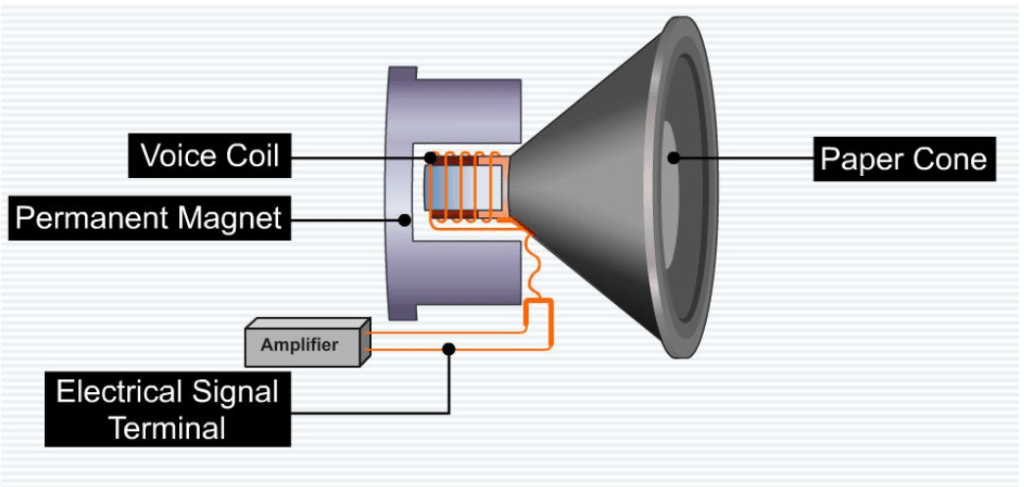
In the case of a loudspeaker (shown above) an alternating current with the same frequency as the desired sound is amplified and sent to the coil. The coil moves backwards and forwards due to the force that is created by the coil’s magnetic field interacting with the loudspeaker’s permanent magnet. The paper cone moves with the coil and makes the air vibrate at the same frequency, creating sound.
In the case of a microphone, the diaphragm is vibrated by external sounds and this causes the coil to move backwards and forwards inside the magnetic field. As a result of this movement, an alternating current is induced in the coil with exactly the same frequency as the back-and-forth movement of the diaphragm and that current can be processed or stored to create amplified or recorded sound.
The fact that these two devices use the same principles, but in reverse, allows an intercom to be built using a combined microphone/loudspeaker at each end. When one person wants to talk, the device at that end acts as a microphone while the device at the other end becomes a loudspeaker. When the other person wants to talk, the opposite happens. All of this is made possible with just one push-button switch at each end, as shown in the diagram below.

There is a excellent video, made by former BBC sound engineer Joe Driver, that explains and demonstrates these ideas in a very simple and understandable way. You can view his TechGrounding-TV video on YouTube via this link.
You should recognise that moving-coil microphones and loudspeakers are simply applications of Fleming’s Left-Hand rule, which is covered in a separate post, here.

 Mr Tarrant's physbang 'blog