Every year, in mid-February, people in the UK (including the Channel Islands) are invited to take part in the CPRE’s annual Star Count. The purpose is to create a map that shows how dark are our skies, based on how many stars can be seen within the constellation of Orion. This year’s event is live now (6-14 February) and it’s very easy to take part: here’s how…
Wait for a cloudless night sky in the early evening, after the Sun has properly set, from about 8pm onward. Go outside and allow your eyes to adjust to the darkness (at least five minutes). Try to avoid being close to street lights but don’t go far from your house as the whole point is to record the star-gazing opportunities close to where you live.
Look to the south and locate the constellation of Orion. South is the direction in which TV satellite dishes face: it’s also the direction that has the rising Sun on your left and the setting Sun on our right. Orion is a large constellation that is probably just covered by your hand when you have a straight arm. It is described as a rectangle with three stars forming a diagonal line about half-way up the rectangle. The photograph below, by Andrew Patterson and published on the BAA website (at https://britastro.org/node/20118) shows what you might see.

The Orion rectangle is located in the middle of the picture and is tilted slightly to the left. The diagonal line of three stars is pointing roughly to the 1 o’clock position. There is a good chance that you will not see as many stars as have been recorded in this photograph but it’s a great indication of how things look in real life.
The image below shows the “rectangle” marked on the CPRE’s explanatory diagram that highlights the area in which stars are to counted. In this case, the rectangle is tilted slightly to the right and the diagonal stars are pointing half-way between 2 o’clock and 3 o’clock. The exact angle of the rectangle, and its height above the horizon, depends on the time at which you are viewing it.
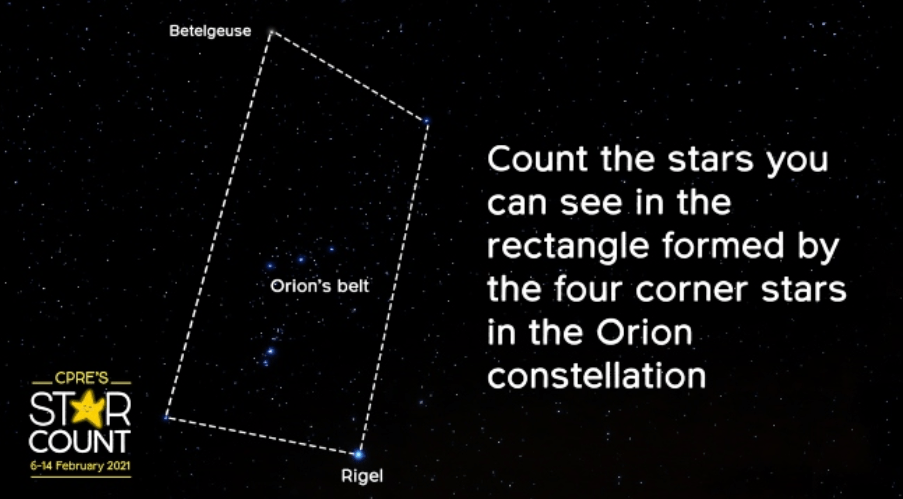
Your task, for Star Count 2021, is to record the number of stars you can see inside the rectangle of Orion when looking up into the night sky at your home location. Don’t count the corner stars but you can include the three diagonal stars (above the words Orion’s belt in the picture above) in your total. When you have a number, which could be anything from fewer than 10 to more than 50, head over to the reporting form and enter your results. If you would like more information, hints and tips, then take a look at the CPRE’s Star Count webpage.
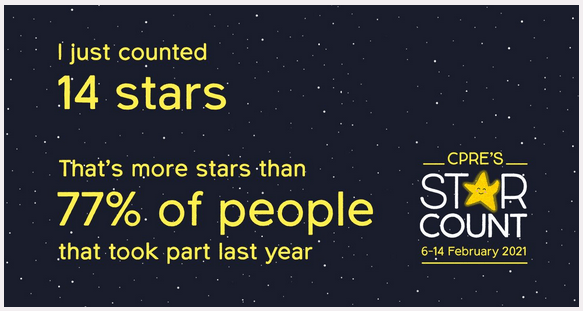
Here’s the confirmation of my own submission: a slightly disappointing number but still better than the majority of people last year! I actually went out twice, about an hour apart, and each time counted three times. My numbers ranged from 12 to 17, all of which fit in the CPRE category for “some light pollution”, which sounds like a fair description for the sky sound of where I live.
Last year there were just three dots on the map for Jersey: let’s try to get more in 2021!

 Mr Tarrant's physbang 'blog
One thought on “Take part in Star Count 2021”