
Sound travels at different speeds in different materials. We often think only of sound moving through the air (a gas) but in fact it also moves through both liquids and solids. Note that there is a difference between sound moving through a liquid and waves that can be seen on the surface of a liquid. (There is more about the speed of surface waves on water in a separate post, which you can read here.)
In general, sound waves move slowest through a gas, slightly quicker through a liquid and fastest through a solid. This can be explained by thinking about how close the particles are in these three states of matter.
Particles are closest in solids and each particle is bound to its neighbour so energy can easily be passed from one particle to the next. The closeness is similar in liquids but there is more freedom of movement for each particle so energy is not transferred as easily. And in gases, particles move independently so energy transfers happen by compressing and expanding (rarefying) regions of gas, which is a slower process than direct particle-to-particle energy transfer.
We have carried out an investigation to determine the speed of sound in a solid using the frequency of the note that is heard when a suspended iron bar is hit sharply using a hammer. The apparatus used is shown in the diagram below. The frequency of the sound was measured using software installed on a smartphone that was held close to the iron bar.
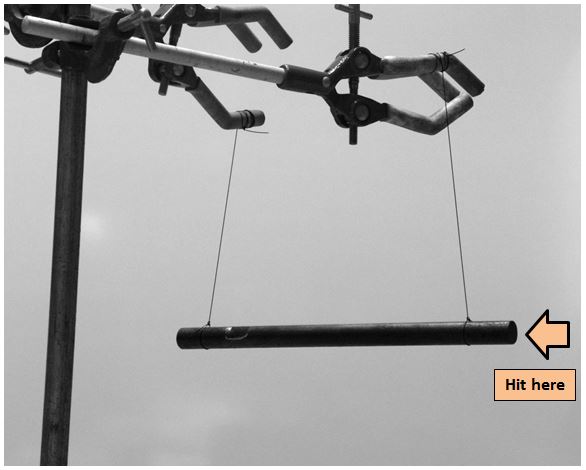
To calculate the speed of sound in the iron bar, we use the wave velocity equation;
wave velocity (m/s) = wavelength (m) x frequency (Hz)
We believe that the iron bar vibrates in a way such that its length is exactly equal to a half wave. This means the wavelength is equal to twice the length of the iron bar.
Therefore we can re-write our wave velocity equation as;
wave velocity (m/s) = 2 x bar-length (m) x frequency (Hz)
The length of the suspended iron bar was 19.9 cm.
The frequency was measured in ten separate tests, giving the results shown below.

Your task is to use the frequency data and the equation provided to calculate an appropriate value for the speed of sound in solid iron. You should then undertake some Internet research to determine the extent to which your result agrees with the true value according to a reliable source.
You will find that our results differ from the true value and you should try to explain why.
HINT: Think about the measurements taken: which measurement must be correct and which might be in doubt. What assumption might also be incorrect?
When you have completed this task, email Mr Tarrant with your calculated value and a short comment comparing your answer with a reliable reference source.

 Mr Tarrant's physbang 'blog