
Given that electromagnetic (EM) waves all have various things in common*, it makes sense to put them in order. We do this using their wavelength or frequency: it doesn’t matter which one we choose because as wavelength increases, frequency decreases (and vice versa).
Putting the different types of EM waves in order creates a spectrum that looks like the diagram below. Note that the visible light spectrum is just one small part of the complete EM spectrum.
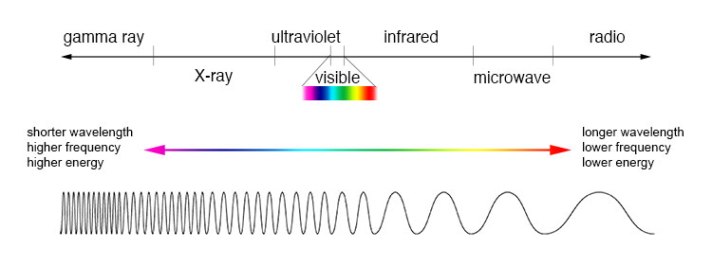
You need to remember the correct order for the sections in the EM spectrum. Some people find it helpful to create a mnemonic using the first letter of each section. A well-known example is;
Red Monkeys In Vans Use X-ray Glasses
But always remember that the sections can be listed either way around: radio waves could be placed first (on the left of the spectrum) or it could be placed last (on the right of the spectrum). There is no “right” or “wrong” way around for the EM spectrum!
You can find out more by reading p77 in your CGP GCSE Edexcel Physics revision guide.
There is also a good video by Michel van Bieven that you can view on YouTube (click here).
You should listen particularly carefully to the middle section when the Bieven is summarising the health dangers of different types of EM waves as this is an aspect that is often included in exam questions.
* The features that all EM waves have in common are;
- they are all transverse waves (the oscillation is perpendicular to the direction of travel)
- they all travel at the same velocity, which we call the speed of light and has a value of about three hundred million metres-per-second (3 x 10^8 m/s)
- they are all generated by the movement of electrons
- they all create simultaneous electric and magnetic fields (hence their name).

 Mr Tarrant's physbang 'blog