
One of the most common misconceptions in GCSE Physics is that a force is needed to keep an object moving. In fact, a force is only needed to produce a change an object’s movement.
This fact is Newton’s First Law of Motion, which is sometimes known as the Law of Inertia.
Inertia is the tendency of all objects to remain at rest or continue moving at the same speed in the same direction. It is the second half of this sentence – the part referring to constant velocity – that many students forget.
The safest way to remember Newton’s First law is: “All objects remain at constant velocity, which might be zero (but may not be) unless they are acted on by an unbalanced force.”
Note that this definition does not say there is NO force: it only says there is no UNBALANCED force.
If a book is placed on a table, and does not move, it is still acted on by gravity and exerts a force on the table (as you can prove by resting the book on a weighing device on the table). But the table exerts an equal and opposite force on the book – provided that the table is strong enough to do this. (See diagram below.)
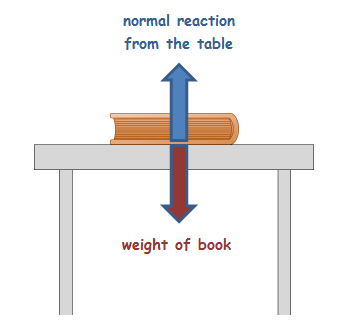
Obviously if you made a table out of a few flimsy sheets of paper then it might not be strong enough to support the book, which would fall until it reached something (the floor) that had enough strength to exert a force on the book that is equal to the weight of the book. And at that point the forces acting on the book would be in equilibrium, so the book would remain stationary.
An everyday example of a moving situation with balanced forces is falling rain. The raindrops start their fall thousands of feet up in the air and have enough time to reach a very high velocity as they fall but when they land on your head they are actually moving at relatively slow speeds.
This happens because the raindrops encounter air resistance as they fall. The force of air resistance increases with speed but the downward force acting on the raindrop (its weight, due to gravity) does not change as it falls. Therefore, there will come a time when the force of air resistance has increased to equal the force of the raindrop’s weight. These forces are not only equal but also in exactly opposite directions, so they “cancel out”. (More correctly, they sum to zero because they are equal and opposite vector quantities, as shown below.)
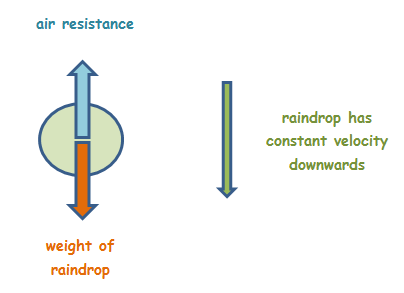
So a falling raindrop reaches a maximum speed in a fixed direction and therefore has constant velocity. As with the stationary book, this does not happen because there is NO force acting on the raindrop but rather because there is no UNBALANCED force acting on the raindrop.
And that is what Newton’s First Law is all about.

 Mr Tarrant's physbang 'blog
One thought on “Newton’s First Law”